Culture
What Time Is the Fourth Watch? How People of Old Divided the Night into Five Watches
In traditional lunar-calendar culture, expressions such as “the drum of the third watch”, “awake until the fourth watch” or “the cock crows at the fifth watch” often appear in literature, folk verse and folk tales. They are traces of a timekeeping system that was widely used before modern clocks became everyday objects.
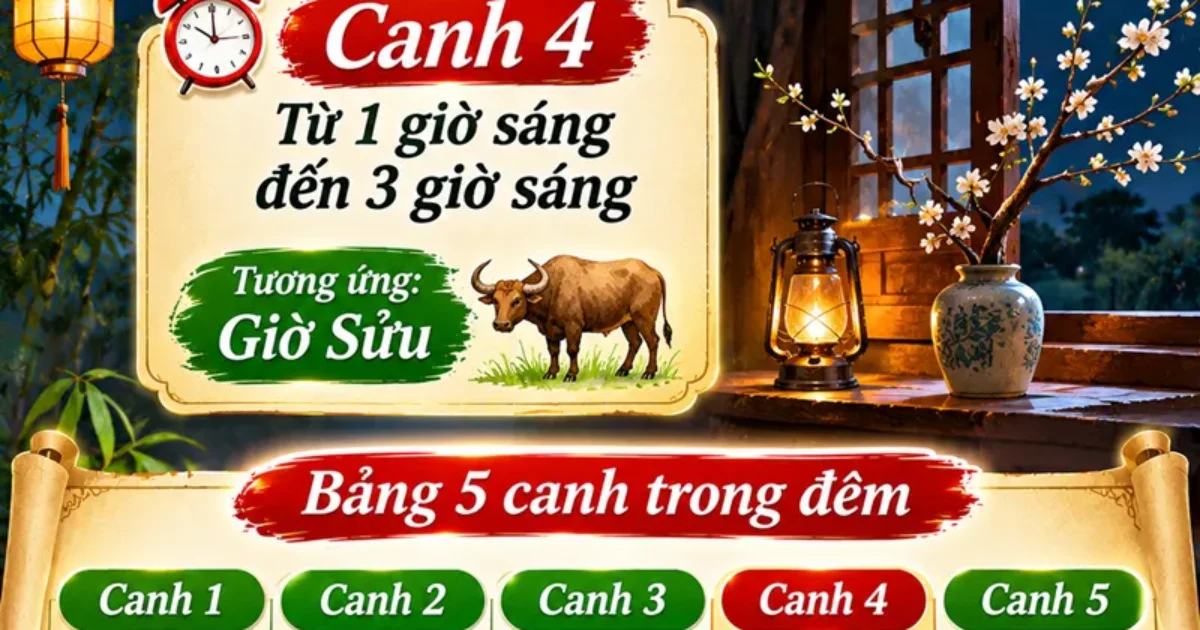
So what time is the fourth watch, which of the 12 zodiac hours does it fall in, and why did people of old divide the night into five watches? In the traditional reckoning, the fourth watch corresponds to roughly 1 a.m. to 3 a.m., which is the Ox hour in the system of 12 earthly branches. It is late in the night, when most daily activity has stopped and dawn has not yet come.
What time is the fourth watch?
The fourth watch runs from 1 a.m. to just before 3 a.m., matching the Ox hour in the 12-branch timekeeping system. It is the fourth of the five traditional night watches.
In the usual division, the night begins at 7 p.m. and ends at 5 a.m. the next morning. This 10-hour span is divided into five watches of two hours each.
The first watch begins at 7 p.m., followed in turn by the second, third, fourth and fifth watches.
So when you hear “awake until the fourth watch”, it means the person was still awake sometime between 1 a.m. and 3 a.m.
In practice, the fourth watch usually refers to a very late hour, when everything is quiet and most people are fast asleep.
For old texts, poetry or historical stories, converting the fourth watch to modern time helps readers picture the time setting being described.
Which zodiac hour is the fourth watch?
The fourth watch corresponds to the Ox hour, one of the 12 branch hours used in the traditional calendar.
This system divides a day and night into 12 periods, each lasting two modern hours. The periods are named in turn Rat, Ox, Tiger, Rabbit, Dragon, Snake, Horse, Goat, Monkey, Rooster, Dog and Pig.
The Ox hour starts at 1 a.m. and ends just before 3 a.m.
Chou (Ox) is the second earthly branch, associated with the ox in the 12-animal system. In folk explanation, this is when the ox rests before the next day’s work.
However, the Ox hour should be distinguished from being born in an Ox year. The Ox hour is a period that occurs every day, while an Ox year refers to a birth year by earthly branch.
So every day has an Ox hour, regardless of the day’s own earthly branch.
Table of the five night watches
People of old often used the five-watch system to identify periods of the night. Each watch corresponds to one branch hour and lasts two hours in modern terms.
| Watch | Modern time | Branch hour | Character of the period |
| Watch 1 | 19:00 – 21:00 | Dog hour | Early evening, when daily activities wind down |
| Watch 2 | 21:00 – 23:00 | Pig hour | Night deepens and many families go to rest |
| Watch 3 | 23:00 – 01:00 | Rat hour | The middle of the night in the five-watch division |
| Watch 4 | 01:00 – 03:00 | Ox hour | Late night, the time before the last watch |
| Watch 5 | 03:00 – 05:00 | Tiger hour | Near dawn, getting ready for early morning |
The table shows that the fourth watch comes after the third watch and before the fifth.
It falls in the second half of the night, but it is not yet dawn.
In the traditional reckoning as commonly converted today, 3 a.m. marks the change from the fourth watch to the fifth.
Why did people of old divide the night into five watches?
Before mechanical and electronic clocks were widely used, people needed other ways to tell the time.
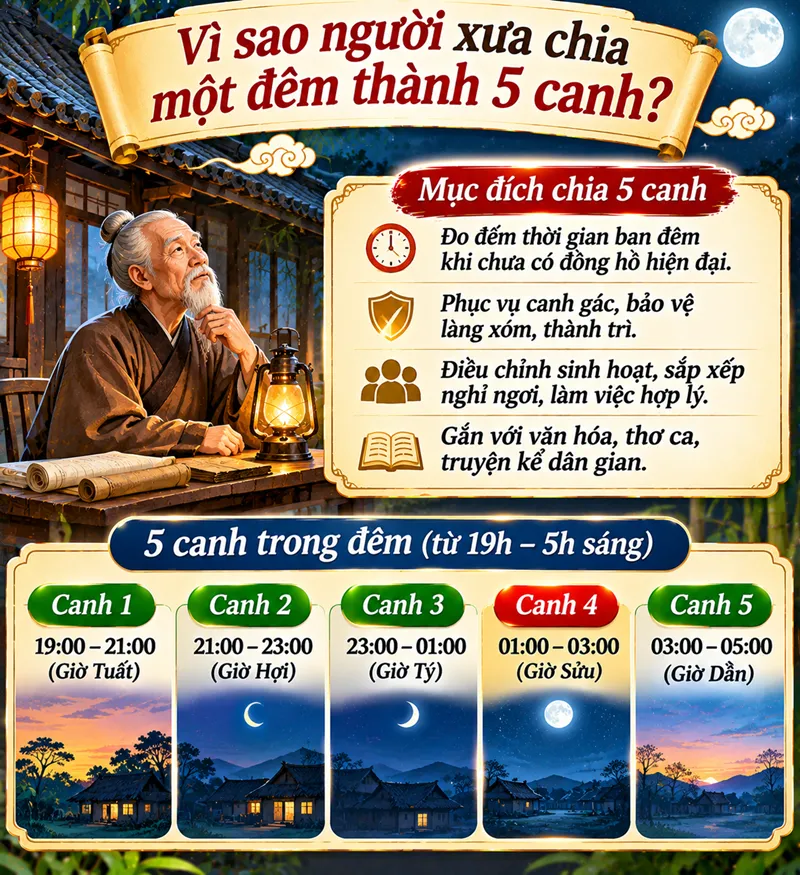
People in the past could rely on the Sun’s position, shadows, the phases of the Moon or natural signs to know the time of day.
At night, however, observing light became harder. So the watch system was used to divide the night into periods that were easy to remember.
In traditional life, the watches were also tied to patrols, guard duty and signalling the time.
In some places, drums or wooden clappers were used to announce the watches so people knew the time of night.
The five watches therefore reflect not only a way of telling time but also the organization of daily life and community protection.
In historical stories and literature in particular, the watch drum is often used to evoke late night, waiting or feelings that are hard to put into words.
How is the fourth watch divided?
In the usual reckoning, the fourth watch lasts two hours, starting at 1 a.m. and ending just before 3 a.m.
If more detail is needed, the fourth watch can be divided into three parts: the beginning, middle and end of the Ox hour.
| Stage | Time span | Name |
| Start of the fourth watch | 01:00 – 01:40 | Beginning of the Ox hour |
| Middle of the fourth watch | 01:40 – 02:20 | Middle of the Ox hour |
| End of the fourth watch | 02:20 – 03:00 | End of the Ox hour |
This division is based on splitting a two-hour branch hour into three equal parts of 40 minutes each.
It is a convenient conversion for pinpointing smaller periods within the Ox hour; it does not mean every old text used exactly these three markers.
In everyday speech, people usually just say the fourth watch or the Ox hour without dividing it further.
Is the fourth watch midnight?
The fourth watch is not the middle of the night in the traditional five-watch division.
In this system, the third watch runs from 11 p.m. to 1 a.m. and includes 12 o’clock, usually called midnight in modern timekeeping.
The fourth watch begins after that, from 1 a.m. to just before 3 a.m.
The difference between the two watches can be seen in the table below.
| Criterion | Watch 3 | Watch 4 |
| Time span | 23:00 – 01:00 | 01:00 – 03:00 |
| Branch hour | Rat | Ox |
| Position in the night | The middle of the night | The second half of the night |
| Common name | Third watch | Fourth watch |
In literature, the third watch often appears when describing midnight, while the fourth watch suggests a later time, when the night has dragged on.
In everyday speech, however, both the third and fourth watches can simply be called late at night.
What does the fourth watch mean in folk culture?
The fourth watch appears in many traditional expressions, especially in stories of sleeplessness, waiting and longing.
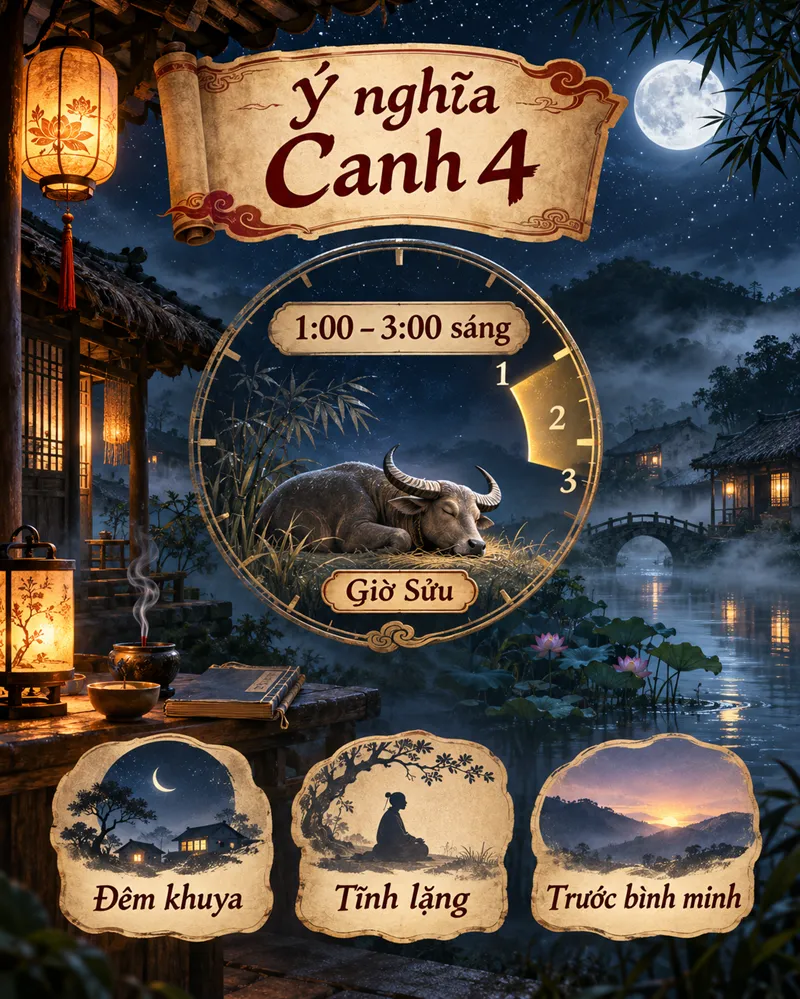
It is a time when most people are asleep, village roads are empty and everyday activity has stopped.
In medieval literature, mentioning the fourth watch can highlight the mood of a character who is awake late, thinking or waiting for something to happen.
In folk tales, the fourth watch is also used to set a quiet scene before daybreak.
These meanings, however, belong mainly to language and cultural symbolism. The fourth watch is not in itself lucky, dangerous or mysterious.
Defining the fourth watch as 1 a.m. to 3 a.m. is first and foremost a time conversion, not a basis for predicting what will happen during those hours.
What does the fourth watch mean in feng shui?
In the system of 12 earthly branches, the fourth watch corresponds to the Ox hour, which belongs to the Earth element and is Yin in the traditional five-element classification.
The Chou (Ox) branch is often associated with accumulation, stability and the ability to maintain a foundation. The image of the ox (or water buffalo) is also tied to diligence, endurance and patience in agrarian culture.
However, the fourth watch is not automatically a good or bad hour. When choosing auspicious, inauspicious or travel hours, people also go by the earthly branch of the day and the specific calendar method.
The same 1 a.m. to 3 a.m. slot may carry a different hour stem-branch each day. For example, the Ox hour on a Jia day is called Yi Chou, while on a Bing day it is called Ji Chou, according to the rule for determining the hour’s heavenly stem.
So you should not judge good or bad fortune or make important decisions based on the fourth watch alone.
What are people born in the fourth watch (Ox hour) like?
In some Zi Wei and Four Pillars methods, the birth hour is one of the data used to set up the chart.
A person born between 1 a.m. and just before 3 a.m. is considered born in the Ox hour under the usual branch-hour division.
In folk belief, the Ox hour is often associated with patience, caution and hard work. This, however, is only a symbolic link with the ox.
When setting up a Zi Wei chart, besides the birth hour you also need the day, month and year of birth and whatever other information the method requires.
In the Four Pillars, the Ox is the earthly branch of the hour pillar, while the heavenly stem of the hour pillar is determined from the heavenly stem of the day.
So two people both born in the fourth watch do not necessarily have the same full hour pillar or the same chart.
There is currently no scientific evidence that being born in the Ox hour determines a person’s character, health or destiny.
Telling apart watches, khac and branch hours
When learning traditional timekeeping, the three concepts of watch, khac and branch hour are easily confused.
Watches are used to divide the night, usually from 7 p.m. to 5 a.m. the next morning, into five periods.
Khac is an old unit of time whose use and length vary between calendar systems. In the folk saying “five watches at night, six khac in the day”, khac refers to divisions of daytime.
Branch hours are a system dividing the whole day and night into 12 periods, each equal to two modern hours.
Comparison of the timekeeping methods
| Criterion | Watch | Khac | Branch hour |
| Scope of use | Mainly at night | Mainly daytime, in folk usage | Both day and night |
| Division | Five watches | Many conventions over different periods | 12 branch hours |
| Length | Two hours per watch in the usual table | No fixed length across all systems | Two hours per branch hour |
| Example | Watch 4 | Daytime khac | Ox hour |
The fourth watch and the Ox hour can be understood as referring to the same period in the common traditional conversion table, but they belong to two different naming systems.
Editorial information
 Written byTechnical & Visual Design TeamThe unit that designs visual diagrams and keeps the website secure.
 Reviewed byContent Review BoardThe unit that screens material and verifies its accuracy.
Last updated: 21/11/2026
References
- JAHH 2019 PDF
- Aslaksen, The Mathematics of the Chinese Calendar
- Ho Ngoc Duc, Leipzig University
- UNESCO, Twenty-Four Solar Terms
- Truong Anh Thuan, The Hiep Ky calendar under the Nguyen dynasty
- Smith, Chinese Almanacs (book review)
- Smith, Fortune-tellers and Philosophers (book review)
- Ziwei doushu, Wikipedia
- Bruun, An Introduction to Feng Shui
- Feuchtwang, LSE eprints
- Bourassa & Peng 1999
- Bond, Feng Shui and Condominium Prices
Content follows our editorial standards of Treasure Land Feng Shui. Results are for reference, based on traditional beliefs.
Related articles

Which Elements Suit Willow Wood? Compatible and Clashing Elements and Lucky Colors
In the sixty-year Jiazi cycle, Willow Wood is a Na Yin element with a distinctive image. Not an ancient hardwood tree or a vast forest, Willow Wood represents the willow,…
19/11/2026 · 15 min read
Does Wood Control Earth? Causes and Remedies in the Five Elements
In five-element feng shui, Wood and Earth have a controlling relationship. Wood represents trees, growth and development, while Earth represents land, stability and nourishment. This difference leaves many people unsure…
18/11/2026 · 10 min read
What Is the Agricultural Calendar? Origins, Calculation and Role in Daily Life
Long ago, before modern weather forecasting, people observed the Moon, the Sun and the changing seasons to decide when to sow and harvest. Over many generations, this experience was combined…
17/11/2026 · 11 min read