
Lunar calendar
How to Read the Lunisolar Calendar Accurately: A Beginner’s Guide
A guide to reading the lunisolar calendar on wall calendars, phones and online. Learn about lunar and Gregorian dates, stem-branches and key dates.
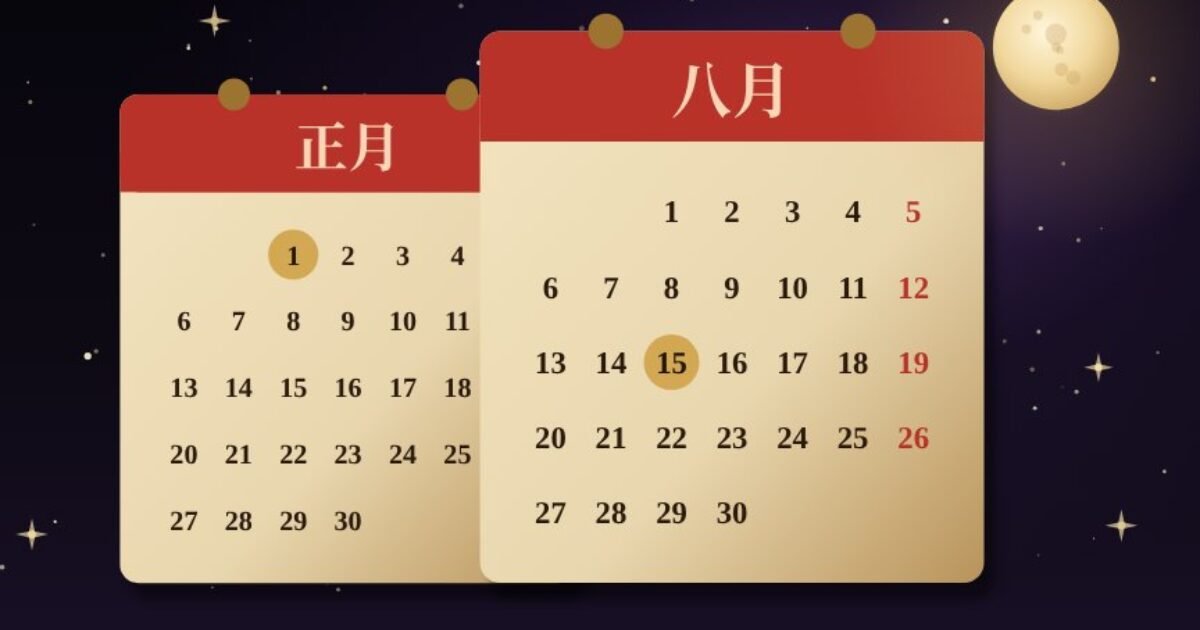
Knowing how to read a lunisolar calendar is a useful skill that helps you keep track of dates, organize your work and prepare for traditional festivals. The Gregorian calendar is widely used in modern life, while the lunar calendar is tied to many traditions such as full-moon festivals, family anniversaries and Lunar New Year.
Today you can read the lunisolar calendar on a wall calendar, a phone app or an online tool. Once you understand how to tell lunar dates from Gregorian dates and a few basic details on the calendar, looking up dates becomes easy.
1. What is the lunisolar calendar? How do the calendars differ?
“Lunisolar calendar” is the common name for a calendar that combines elements of the Moon’s cycle and the Sun’s cycle. The solar (Gregorian) calendar is based mainly on the Earth’s orbit around the Sun, while the traditional lunar calendar is based on the cycle of the Moon’s phases.
The traditional lunar calendar is a lunisolar calendar: its months follow the Moon’s cycle, and leap months are used to keep it in step with the solar year.
| Criterion | Gregorian calendar | Traditional lunisolar calendar |
| Basis of the calendar | The solar year cycle | Months follow the Moon’s cycle, adjusted to the solar year |
| Month length | 28–31 days | Usually 29 or 30 days |
| How days are determined | Day, month, solar year | Day, month, lunar year |
| Common uses | Work, school and administrative schedules | Lunar New Year, death anniversaries, full-moon and new-moon days and traditional customs |
For example, the 15th day of the 8th lunar month is the Mid-Autumn Festival. The matching Gregorian date changes every year, so you need to check the calendar to know the exact date in the current year.
2. How to read the lunisolar calendar on a wall calendar
Tear-off calendars, sheet calendars and wall calendars are familiar tools for following lunar and Gregorian dates at the same time. Depending on the design, the position and size of the numbers may vary.
| Where the information is | Meaning | How to read it |
| The large number on the sheet | Gregorian date | Shows the day of the Gregorian month, e.g. the 24th |
| The small number in the corner or beside it | Lunar date | Shows the matching lunar day, e.g. the 15th |
| The stem-branch line | The names of the day, month and year in the stem-branch system | May show names such as Jia Zi, Ren Chen or Ding Wei |
| Extra information | Solar terms, auspicious hours and other notes | Depending on the calendar, it may give extra reference information |
Note: Not every calendar is laid out the same way. Check the calendar’s legend to identify exactly which number is the lunar date and which is the Gregorian date.
How to read lunar and Gregorian dates
Suppose a calendar sheet shows a large 24 and a small 15. If the legend confirms that the large number is the Gregorian date and the small one is the lunar date, it means the 24th in the Gregorian calendar corresponds to the 15th lunar day.
When you need to find the 1st or the full-moon day, look for the matching lunar day number. The 1st is the first day of the lunar month, and the full-moon day is commonly the 15th lunar day.
How to read stem-branch information on the calendar
Some calendars also show the stem-branch of the day, month and year. This is a traditional naming system formed by combining the 10 Heavenly Stems and the 12 Earthly Branches.
You may see names such as Jia Zi, Yi Chou, Bing Yin or Ding Wei. This information is often used in calendar culture and in folk date-selection.
Don’t confuse the stem-branch of the day with the stem-branch of the year. Each describes a different unit of time.
3. How to read the lunisolar calendar on your phone and online
If you don’t have a paper calendar, you can look up the lunisolar calendar on your phone or computer. Common methods include searching online, using a calendar app and adding a calendar widget to your home screen.
| Method | How to do it | Advantages |
| Google search | Type a phrase such as “lunar calendar today” or “lunar calendar August 2027” | Fast and convenient, no app needed |
| Calendar app | Install a suitable lunisolar calendar app from an official app store | Usually supports converting lunar to Gregorian dates, monthly views and reminders |
| Phone widget | Add a calendar widget from the installed app to your home screen if supported | Quick view of the lunar and Gregorian dates |
| Online calendar website | Visit a calendar site that lets you look up days, months and years | Lets you view monthly calendars and look up specific dates |
How to check the lunar calendar on Google
You can follow these steps:
- Open Google on your phone or computer.
- Type “lunar calendar today” to look up the current date.
- If you want a specific day, enter the full day, month and year you need.
- Check the result against a reliable calendar source if the information matters for something important.
For traditional festivals or a planned event date, check the specific year, because lunar and Gregorian dates do not have a fixed correspondence.
How to check the lunar calendar with a mobile app
You can find lunisolar calendar apps on the App Store or Google Play. Some apps offer features such as monthly views, lunar–Gregorian conversion and reminders for full-moon and new-moon days.
When choosing an app, check its last update date, its calendar data source, the permissions it requests and user reviews. Don’t assume every app has equally accurate data.
4. How to convert Gregorian dates to lunar dates and back
Converting Gregorian dates to lunar dates is a common need when working out death anniversaries, lunar birthdays, full-moon days or traditional festivals.
The simplest way is to use an online lunar–Gregorian converter or the conversion function of a calendar app.
Gregorian to lunar
Enter the full Gregorian day, month and year. The tool will return the matching lunar date in the calendar system it uses.
For example, if you want to know which lunar date your Gregorian birthday falls on, enter the exact birth year as well. Don’t enter only the day and month, as the lunar result can differ between years.
Lunar to Gregorian
If you know the lunar date but want the Gregorian date to book an appointment, enter the lunar day, month and year to convert.
Note that a lunar month can be a regular month or a leap month. If the date to convert is in a leap month, choose the leap month correctly in the tool; otherwise the result may be wrong.
5. Tips for remembering the important lunar dates of the year
You can memorize a few familiar cultural markers to make following the calendar easier. However, these are only approximations and do not replace looking up the exact date.
| Occasion or marker | Lunar date or usual timing | Note |
| Lunar New Year | 1st day of the 1st lunar month | Usually falls in late January or February |
| Lantern Festival | Full moon of the 1st lunar month | 15th day of the 1st lunar month |
| Qingming Festival | Usually in early April | The exact time may vary from year to year |
| Dragon Boat Festival | 5th day of the 5th lunar month | The Gregorian date changes every year |
| Mid-Autumn Festival | Full moon of lunar month 8 | Usually falls in September or early October |
| Winter Solstice | Usually around 21 or 22 December | A solar-term marker based on the apparent position of the Sun |
A note on leap months: Leap months are added according to the rules of the lunisolar calendar to correct the gap between lunar months and the solar year. Don’t rely on the Winter Solstice alone to work out the leap month yourself; check the calendar for the specific year or use a reliable calendar source.
6. How to find good days and Yellow Path days on the lunisolar calendar
Besides looking up dates, many people also consult the lunisolar calendar for good days and Yellow Path days when planning a wedding, a grand opening, moving house or other important undertakings.
On some perpetual calendars you can find information on Yellow Path days, auspicious hours, Black Path days, day officers or stem-branch elements. These belong to traditional calendar systems and beliefs.
When consulting good days, keep in mind:
- Get the date right: Check both the lunar and the Gregorian date to avoid mix-ups.
- Match the purpose: Date-selection beliefs can differ by type of event and by school.
- Compare several factors: Don’t conclude a day is good or bad from a single factor.
- Prioritize practical conditions: For work, weddings or moving house, also consider schedules, health, budget and family circumstances.
Beliefs about good days and Yellow Path days are cultural, traditional and for reference; they are not a scientific basis for guaranteeing the outcome of an event.
You can visit Treasure Land Feng Shui for more on the lunisolar calendar, traditional customs and Zi Wei astrology.
Conclusion
Reading the lunisolar calendar isn’t hard once you can tell lunar dates from Gregorian dates and understand the information that usually appears on a calendar. You can look things up on a wall calendar, your phone or an online site, depending on your needs.
For traditional festivals, death anniversaries or important events, enter the full day, month and year and check carefully for leap months. If you want to learn more about traditional calendars, customs and Zi Wei astrology, you can read the articles at Treasure Land Feng Shui.
Editorial information
 Written byTechnical & Visual Design TeamThe unit that designs visual diagrams and keeps the website secure.
 Reviewed byContent Review BoardThe unit that screens material and verifies its accuracy.
Last updated: 21/11/2026
References
- JAHH 2019 PDF
- Aslaksen, The Mathematics of the Chinese Calendar
- Ho Ngoc Duc, Leipzig University
- UNESCO, Twenty-Four Solar Terms
- Truong Anh Thuan, The Hiep Ky calendar under the Nguyen dynasty
- Smith, Chinese Almanacs (book review)
- Smith, Fortune-tellers and Philosophers (book review)
- Ziwei doushu, Wikipedia
- Bruun, An Introduction to Feng Shui
- Feuchtwang, LSE eprints
- Bourassa & Peng 1999
- Bond, Feng Shui and Condominium Prices
Content follows our editorial standards of Treasure Land Feng Shui. Results are for reference, based on traditional beliefs.