
Chinese Astrology
What Is the Parents Palace in Zi Wei? Star Meanings and How to Read It

In a Zi Wei chart, each palace represents a particular aspect of life. If the Life palace gives an overview of the person, the Parents palace in Zi Wei focuses on the image of the parents, the family background and the relationship between children and those who raised them. It is also the palace used to read support from elders, teachers, superiors and others who play a guiding role in life.
To understand the Parents palace correctly, don’t look at one main star and conclude that the parents are good or bad. The reading must place the stars present in relation to the minor stars, killing stars, brightness (Temple – Prosperous – Favourable – Fallen), Xun, Jie and the related palaces. Each factor can add to or change the nuance of the palace’s meaning.
1. What is the Parents palace in Zi Wei?
The Parents palace is the second palace in the 12-palace layout used here, coming after the Life palace in the clockwise direction and before the Fortune palace. It is one of the important palaces for exploring family circumstances, the influence of parents and the bond between generations.
The name Parents is not limited to father and mother in the literal sense. In traditional reading, this palace is extended to elders who have a significant influence on the person, such as teachers, mentors, superiors or patrons.
The Parents palace is usually considered in three respects:
- Image of the parents: Reflects some features of the parents’ character, education, abilities, economic situation, social standing and circumstances in Zi Wei reading.
- Family affection: Shows the tendency toward harmony, closeness, disagreement or distance between parents and children.
- Support from elders: Shows the ability to receive guidance, help or patronage from older people, teachers and superiors.
Note that these are interpretations of the traditional Zi Wei system. A single palace is not enough to determine precisely the parents’ character, lifespan, health or real circumstances.
2. Which aspects does the Parents palace reflect?
2.1. The image and circumstances of the parents
One of the things people look for in the Parents palace is the parents’ circumstances. The main and minor stars in the palace are used to read the temperament, conduct, abilities, education and living conditions of the parents.
In the common Zi Wei conventions:
- Tai Yang is usually used to represent the father.
- Tai Yin is usually used to represent the mother.
When reading, consider whether these two stars are bright or dim, and combine them with the stars in the same palace and the related palaces. Don’t conclude the parents’ whole situation just from the presence of Tai Yang or Tai Yin.
2.2. The relationship between parents and children
The Parents palace is also used to consider how close the person is to their parents. Some star combinations are read as a harmonious family with caring parents able to support their children. Others may indicate differences of opinion, emotional distance or circumstances that make children independent early.
However, disharmony in a Zi Wei reading does not necessarily mean parents and children don’t love each other. Sometimes differences in personality, outlook, parenting style or family circumstances are also interpreted through this palace.
2.3. Support from teachers and superiors
Beyond its direct meaning about parents, the Parents palace is extended to relationships with people of the previous generation or in higher positions.
For example, when considering study and work, this palace can be consulted for the tendency to receive guidance from teachers, managers or experienced people. This is a supplementary perspective and does not replace looking at the palaces related to study, career and social relationships.
3. The main stars in the Parents palace
In Zi Wei Dou Shu, the main star present is one of the key bases for reading the Parents palace. Each star has its own symbolic character, but its specific meaning also depends on whether it is in a Temple, Prosperous, Favourable or Fallen position and on how other stars combine with it.
3.1. Main stars that usually carry favourable meanings
Some main stars in the Parents palace are usually read as parents of good character and ability, with fairly stable living conditions or the ability to support their children.
- Zi Wei: Usually associated with a person of prestige, standing and management ability. With favourable combinations, it may be read as parents who have a voice in the family or in society.
- Tian Fu: Signifies stability, management and accumulation. In the Parents palace, this star is usually read as a family with a fairly solid foundation.
- Tian Xiang: Symbolises integrity, responsibility and supportiveness. With favourable combinations, it is usually read as parents who care for and look after their children.
- Tian Liang: Associated with kindness, protection and experience. This star is often seen as a symbol of elders who tend to advise and guide the younger generation.
- Tai Yang: When bright, it is usually read as a father who is capable, respected or a positive influence on the family.
- Tai Yin: When bright, it is usually read as a mother who is caring, good at managing the household or able to build a stable foundation for the family.
These meanings are only general. The same main star can be read quite differently when its position and star combinations change.
3.2. Main stars that need careful consideration in the Parents palace
Some main stars are often mentioned in Zi Wei texts when reading disagreements, distance or hardship in family relationships. However, don’t assume that these stars always mean parents and children are at odds.
- Wu Qu: May be read as a firm character that values principle or material things. In some combinations, this can create distance in how affection is shown.
- Ju Men: Associated with speech, debate and opinions. When it meets adverse factors, it may indicate differences in communication between parents and children.
- Seven Killings: Strong, decisive and strict in nature. Consider the facing stars as well to assess its influence on family relationships.
- Po Jun: Usually associated with change and independence. In the Parents palace, it may be read as family circumstances with many changes.
- Tian Ji: Linked with thinking, flexibility and change. The reading should pay attention to the star’s condition and the accompanying factors.
- Lian Zhen: May indicate a principled, serious nature or issues of boundaries and opinions within the family.
- Tan Lang: Carries a nuance of desires, communication and relationships. Its specific meaning depends heavily on the star combination.
- Tian Tong: Usually associated with a gentle, emotional nature and change. When it meets adverse stars, it may be read as instability in some aspects of family life.
The key point is that none of these stars can be classed as absolutely bad. A main star can carry different meanings when it is well placed, supported by auspicious stars or affected by killing stars.
4. The influence of minor and killing stars in the Parents palace
If the main star shows the dominant traits, the minor and killing stars add nuance to the reading. So when looking at the Parents palace, observe the accompanying stars too rather than just reading the name of the main star.
4.1. The six killing stars
The six killing stars usually mentioned are:
- Di Kong: May indicate instability, interruption or unpredictable changes.
- Di Jie: Usually read as upheaval, obstacles or loss.
- Qing Yang: Hard, conflictual and confrontational in nature.
- Tuo Luo: Associated with stagnation, entanglement or matters that are hard to settle once and for all.
- Huo Xing: Hot-tempered, sudden and prone to clashes.
- Ling Xing: Usually seen as adding instability or unpredictable problems.
When these stars appear in the Parents palace, some schools may read disagreements between generations, challenging family circumstances or distance. Even so, consider the star’s position, how strongly it combines and the layout of the whole chart before making a judgement.
4.2. Hua Ji in the Parents palace
Hua Ji is usually seen as a factor to watch when reading the Parents palace. In traditional interpretation, this star may be associated with entanglements, misunderstandings, worry or things that are hard to talk about in family relationships.
Depending on the star combination, Hua Ji may be read as:
- Parents and children finding it hard to see eye to eye.
- Misunderstandings arising easily from communication styles or differing views.
- The person having many thoughts and worries about family.
- Relationships with elders or superiors meeting obstacles at certain times.
Don’t conclude that a family will certainly be in conflict just because Hua Ji is present. Distinguish its effect from the supporting or relieving factors in the whole chart.
5. What does an empty Parents palace mean?
An empty Parents palace is when no main star sits in the palace. This structure needs its own way of reading, because there is no dominant main star from which to determine the palace’s character.
According to some traditional readings, an empty Parents palace may be associated with signs such as:
- The person feeling less deeply connected to their parents at certain times.
- Changes or a lack of stability in family circumstances.
- Children tending to become independent early.
- Support from parents not being clearly visible or not coming in the way the person hopes.
However, an empty palace does not mean having no parents, lacking love or certainly living far from family. When reading it, consider the facing stars, especially the opposite palace and the related factors in the trine.
So if the Parents palace is empty, don’t rush to conclusions just from the absence of a main star. Assess the overall layout of the chart to better understand this structure.
6. Xun and Jie in the Parents palace
Xun and Jie are two factors often considered when reading the Parents palace. When they appear here, they can change how the meanings of the stars present or facing are expressed.
In traditional Zi Wei, Xun and Jie are usually considered in the following respects:
- Effect on main stars: They may change how strongly a star expresses itself, so its favourable or adverse meaning no longer shows in the usual way.
- Parent–child relationship: Some readings hold that they may indicate distance, obstacles in communication or a lack of continuity in family relationships.
- Living circumstances: They may be interpreted as a change of living environment, distance from parents or having to be independent at certain times.
Don’t take Xun or Jie as factors that always worsen the Parents palace. Their specific effect must be placed in relation to the main stars, minor stars and the whole layout of the chart.
7. How the Parents palace relates to other palaces
An important principle in Zi Wei reading is not to isolate one palace when drawing conclusions. The Parents palace must be considered in relation to the palaces that oppose it and form trines with it.
7.1. The Parents palace opposes the Health palace
The Parents palace is opposite the Health palace. In traditional reading, this link may be consulted when considering issues of health, physical condition and family factors.
However, this opposition alone should not be used to conclude anything about illness, heredity or the parents’ lifespan. Real health issues must be assessed with appropriate medical information.
7.2. The Parents palace forms a trine with the Friends and Children palaces
The Parents palace forms a trine with the Friends palace and the Children palace. These three palaces can be considered together to broaden the view of social relationships, support and relationships between generations.
- Friends palace: Linked with friends, helpers and social relationships. Combined with the Parents palace, it can add perspective on help from others or from people of standing.
- Children palace: Linked with children and the next generation. Viewed with the Parents palace, it broadens the view of family relationships across generations.
Combining palaces helps avoid one-sided judgements based on just a few stars in the Parents palace.
8. Looking up the Parents palace on your Zi Wei chart
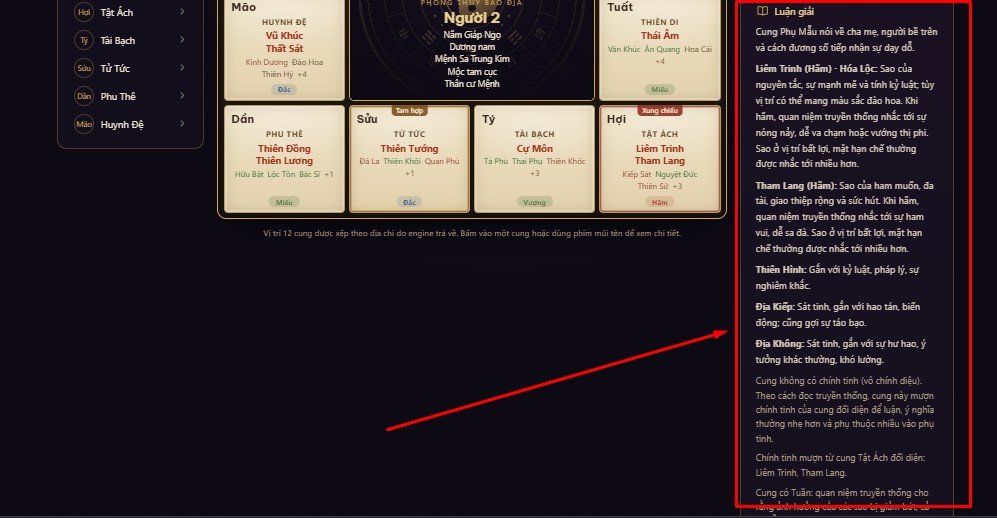
To know which main and minor stars are in your Parents palace, first set up a chart from your day, month, year and hour of birth. Once you have the chart, find the Parents palace box and note the stars present, the facing stars and special signs such as an empty palace, Xun or Jie.
You can use the Zi Wei chart tool at Bao Dia Feng Shui to create a chart and see the layout of the 12 palaces. Enter your birth date and hour as accurately as possible; if you don’t remember your birth hour, note that missing this information may affect how complete the reading is.
Once you have identified the stars in the Parents palace, combine them with the related palaces for a fuller view of family matters and relationships with elders.
The Parents palace in Zi Wei is used not only to read about parents but also reflects the traditional view of family background, the bond between generations and the influence of elders. To understand it correctly, combine the main stars, minor stars, killing stars, Xun, Jie and the related palaces rather than drawing conclusions from a single sign.
Editorial information
 Written byTechnical & Visual Design TeamThe unit that designs visual diagrams and keeps the website secure.
 Reviewed byContent Review BoardThe unit that screens material and verifies its accuracy.
Last updated: 21/11/2026
References
- The calendars of Southeast Asia. 3: Vietnam (NASA ADS)
- JAHH 2019 PDF
- Aslaksen, The Mathematics of the Chinese Calendar
- Ho Ngoc Duc, Leipzig University
- Le Thanh Lan, VieChiCa
- UNESCO, Twenty-Four Solar Terms
- Truong Anh Thuan, The Hiep Ky calendar under the Nguyen dynasty
- Smith, Chinese Almanacs (book review)
- Smith, Fortune-tellers and Philosophers (book review)
- Ziwei doushu, Wikipedia
- Bruun, An Introduction to Feng Shui
- Feuchtwang, LSE eprints
- Bourassa & Peng 1999
- Bond, Feng Shui and Condominium Prices
Content follows our editorial standards of Bao Dia Feng Shui. Results are for reference, based on traditional beliefs.
Related articles
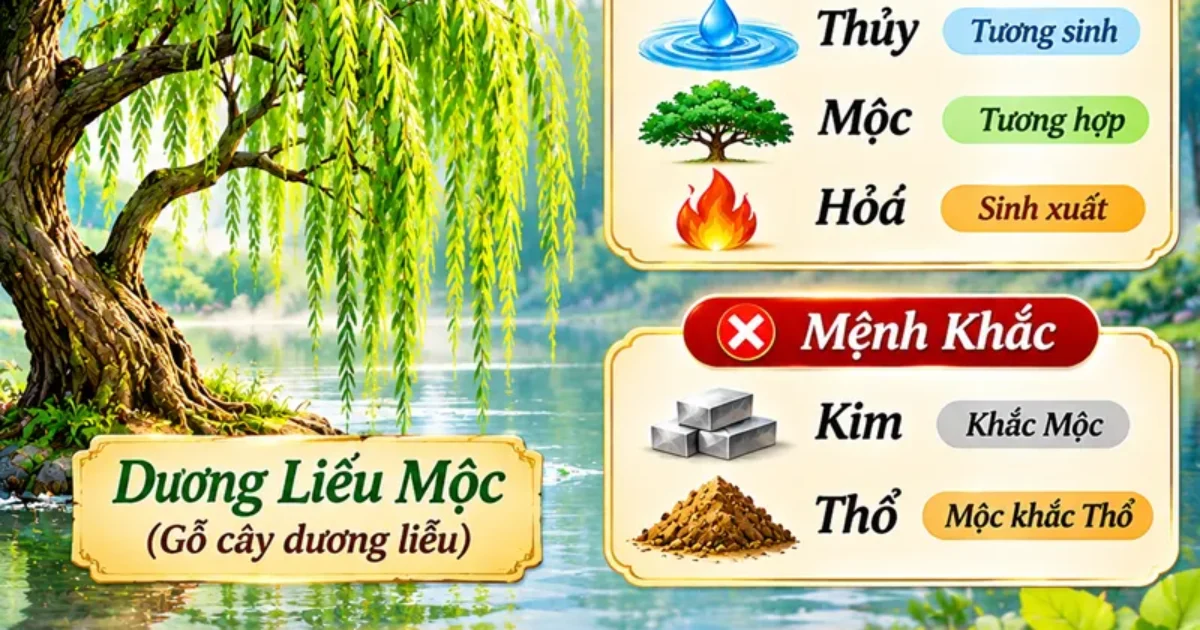
Which Elements Suit Willow Wood? Compatible and Clashing Elements and Lucky Colours
In the sixty-year Jiazi cycle, Willow Wood is a Na Yin element with a distinctive image. Not an ancient hardwood tree or a vast forest, Willow Wood represents the willow,…
19/11/2026 · 15 min read
Does Wood Control Earth? Causes and Remedies in the Five Elements
In five-element feng shui, Wood and Earth have a controlling relationship. Wood represents trees, growth and development, while Earth represents land, stability and nourishment. This difference leaves many people unsure…
18/11/2026 · 10 min read
What Is the Su Xi Hour? Meaning, Calculation and What to Do
In the tradition of choosing days and hours, Su Xi (Swift Joy) is seen as a time that brings joy, luck and favourable turns in one’s affairs. People in the…
16/11/2026 · 9 min read