
Chinese Astrology
What to Keep in Mind When Checking Auspicious Hours: 6 Key Points
What should you keep in mind when checking auspicious hours? Learn how to check the date, the Rat hour, the age of the person leading the event and choose a suitable time slot by custom.

What should you keep in mind when looking up auspicious hours to choose the right time for an important undertaking? Besides identifying the slots considered good by the traditional calendar, you need to check the lunar date, the timekeeping convention, the age of the person leading the event and the nature of the task. These factors make the lookup more systematic and avoid confusing the general auspicious hours with hours chosen by particular criteria.
1. Check the correct date and timekeeping convention
One of the first things to note when looking up auspicious hours is to identify the exact day. If you pick the wrong Gregorian date or match the wrong lunar date, the good hours may not correspond to when you plan to act.
You should check the following:
- The Gregorian date and the corresponding lunar date.
- The day’s stem-branch.
- The time zone used to display the result.
- The day-change convention at the Rat hour, if the tool offers this option.
In particular, the Rat hour runs from 23:00 to 01:00, so it can affect how days are divided in some calendar methods. For example, the Auspicious Hours tool at Bao Dia Feng Shui has an option to change the day at 00:00 and distinguishes early Rat from late Rat.
When looking up, keep your settings consistent if you need to compare results across several days or sources.
2. Don’t look only at the hour’s name and ignore the actual time
In the 12-branch division, each traditional hour corresponds to about two hours on a modern clock. For example, the Dragon hour is 07:00–09:00, the Horse hour 11:00–13:00 and the Dog hour 19:00–21:00.
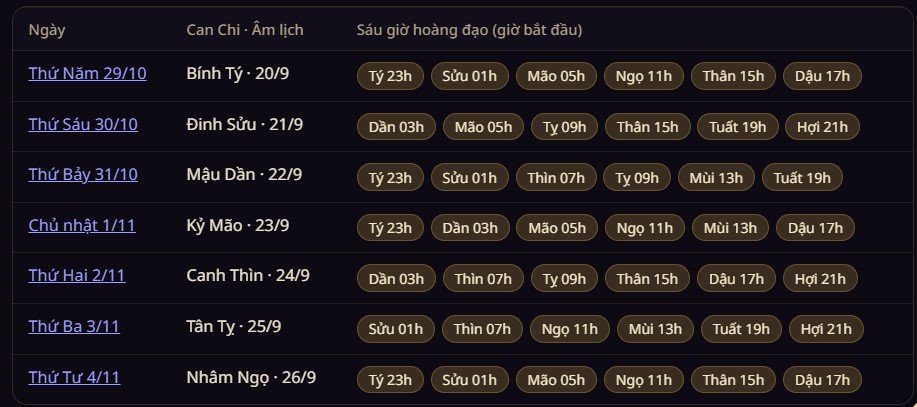
However, seeing the name of a familiar hour doesn’t mean it is always an auspicious hour. Yellow Path or Black Path classification must be looked up for the specific day and method in use.
When viewing the result, note both the start and end times rather than just remembering the branch name. This is especially important when deciding the departure time, the start of a ceremony or the moment of signing.
Some folk beliefs advise against choosing a time too close to the boundary between two slots. Even so, there is no confirmed universal rule that every task must be done in the exact middle of a slot or offset by a fixed number of minutes. Treat this as reference experience, not a requirement of every method.
3. Consider the age of the person leading the event if following custom
Auspicious hours are looked up by day, but some feng shui methods also consider the relationship between the chosen hour and the age of the person carrying out the task.
In traditional branch belief, pairs such as Rat – Horse, Ox – Goat, Tiger – Monkey, Rabbit – Rooster, Dragon – Dog and Snake – Pig are classed as the Six Clashes. People following a method that avoids age clashes can use this to choose among the available auspicious slots.
Besides the branches, some schools also consider the heavenly stems and five elements. However, how these factors are combined is not entirely the same across methods.
Don’t rely only on birth year to conclude that an hour is definitely good or bad. If you want to factor in age, be clear about the method applied and compare the auspicious slots first before choosing.
4. Choose an hour that suits the nature of the task
Not every task needs the same way of choosing an hour. Depending on the purpose, you can set more suitable lookup criteria.
| Activity | Things to consider |
| Travel | The actual departure time, transport and itinerary. If following custom, you may also consult the direction of travel. |
| Grand opening | The opening time, the shop’s preparation and the schedule for welcoming customers. |
| Weddings | The ceremony schedule, agreement between the two families and the chosen customs. |
| Groundbreaking, moving house | Preparation time, construction or moving conditions and ceremonial requirements. |
| Signing contracts | Each party’s work schedule, deadlines and ability to complete the paperwork. |
For tasks with many requirements, prioritise practical conditions before narrowing choices by custom. For example, on a long journey, ensuring your health, vehicle and road safety matters more than sticking to a slot that doesn’t fit your schedule.
If you also consult the travel direction or auspicious stars, distinguish these as additional criteria, not information automatically determined from the name of the auspicious hour.
5. Consider both day and hour without equating the two
Another important point is distinguishing Yellow Path days from auspicious hours.

A Yellow Path day is the result of classifying days under a calendar system. Auspicious hours are the slots classed as Yellow Path within a specific day. The two are related but not synonymous.
So if you want to choose a time by traditional belief, you can look up the day first and then the auspicious slots within it. If you want to consider age-compatible days, days to avoid or other criteria, check them with the corresponding method.
Don’t assume an auspicious hour automatically cancels every unfavourable factor of the day. Nor should you conclude that if a day is unsuitable, none of its slots can be used. The specific result depends on the day-and-hour system chosen.
6. Cross-check when sources give different information
When looking up on several websites, you may find the lists of auspicious hours are not exactly the same. The cause may be the calculation method, the Rat-hour convention, how data are presented or the calendar system applied.
If this happens, check in turn:
- Are both sources looking at the same Gregorian and lunar date?
- Is the day’s stem-branch the same?
- Is the day-change convention at the Rat hour consistent?
- Do both sources use the same method of classifying auspicious hours?
If differences remain, choose one system with a clearly presented method and use it consistently for reference, rather than piecing together results from different methods.
You can use the Auspicious Hours tool – Bao Dia Feng Shui to look up the lunar date, the day’s stem-branch, the classification of hours in the day and the auspicious-hour calendar for the next 7 days or the whole month. The tool also shows the hour deities and a comparison of the lookup methods supported on the page.
Editorial information
 Written byTechnical & Visual Design TeamThe unit that designs visual diagrams and keeps the website secure.
 Reviewed byContent Review BoardThe unit that screens material and verifies its accuracy.
Last updated: 21/11/2026
References
- The calendars of Southeast Asia. 3: Vietnam (NASA ADS)
- JAHH 2019 PDF
- Aslaksen, The Mathematics of the Chinese Calendar
- Ho Ngoc Duc, Leipzig University
- Le Thanh Lan, VieChiCa
- UNESCO, Twenty-Four Solar Terms
- Truong Anh Thuan, The Hiep Ky calendar under the Nguyen dynasty
- Smith, Chinese Almanacs (book review)
- Smith, Fortune-tellers and Philosophers (book review)
- Ziwei doushu, Wikipedia
- Bruun, An Introduction to Feng Shui
- Feuchtwang, LSE eprints
- Bourassa & Peng 1999
- Bond, Feng Shui and Condominium Prices
Content follows our editorial standards of Bao Dia Feng Shui. Results are for reference, based on traditional beliefs.
Related articles
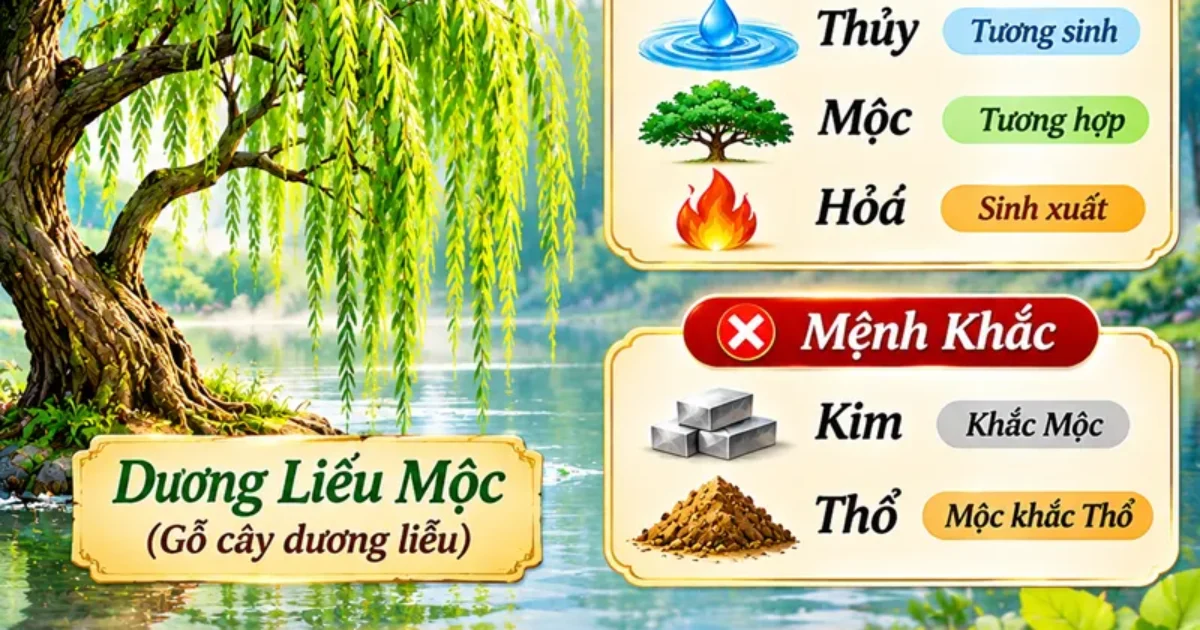
Which Elements Suit Willow Wood? Compatible and Clashing Elements and Lucky Colours
In the sixty-year Jiazi cycle, Willow Wood is a Na Yin element with a distinctive image. Not an ancient hardwood tree or a vast forest, Willow Wood represents the willow,…
19/11/2026 · 15 min read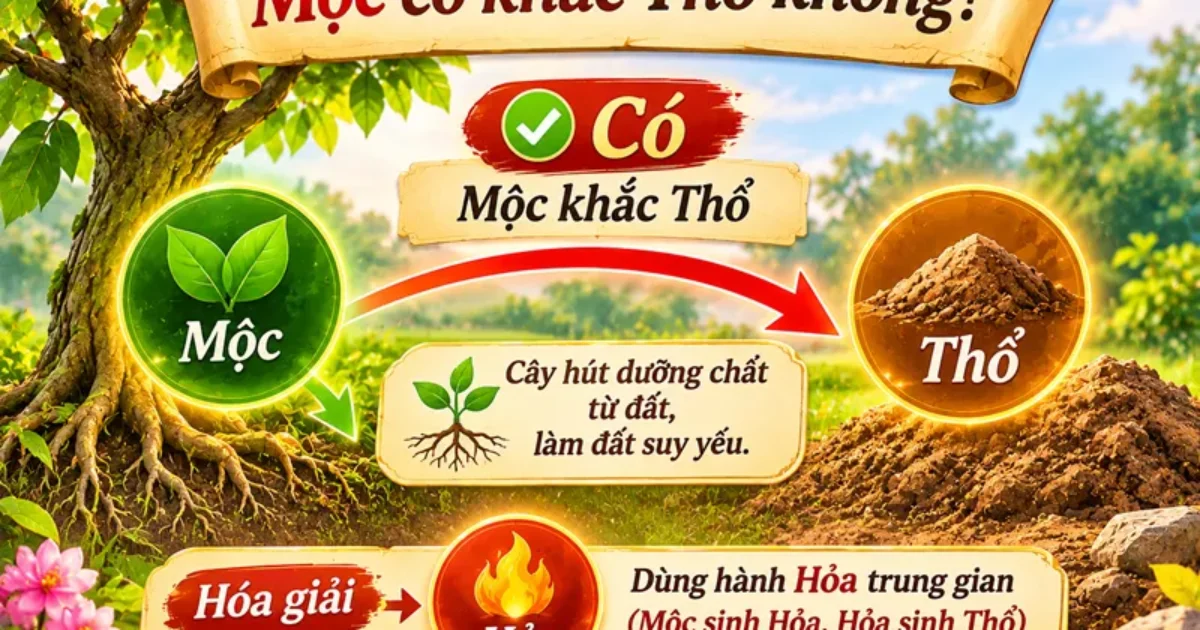
Does Wood Control Earth? Causes and Remedies in the Five Elements
In five-element feng shui, Wood and Earth have a controlling relationship. Wood represents trees, growth and development, while Earth represents land, stability and nourishment. This difference leaves many people unsure…
18/11/2026 · 10 min read
What Is the Su Xi Hour? Meaning, Calculation and What to Do
In the tradition of choosing days and hours, Su Xi (Swift Joy) is seen as a time that brings joy, luck and favourable turns in one’s affairs. People in the…
16/11/2026 · 9 min read