
Chinese Astrology
Can You Set Up a Zi Wei Chart Without Knowing Your Birth Hour? How to Determine It
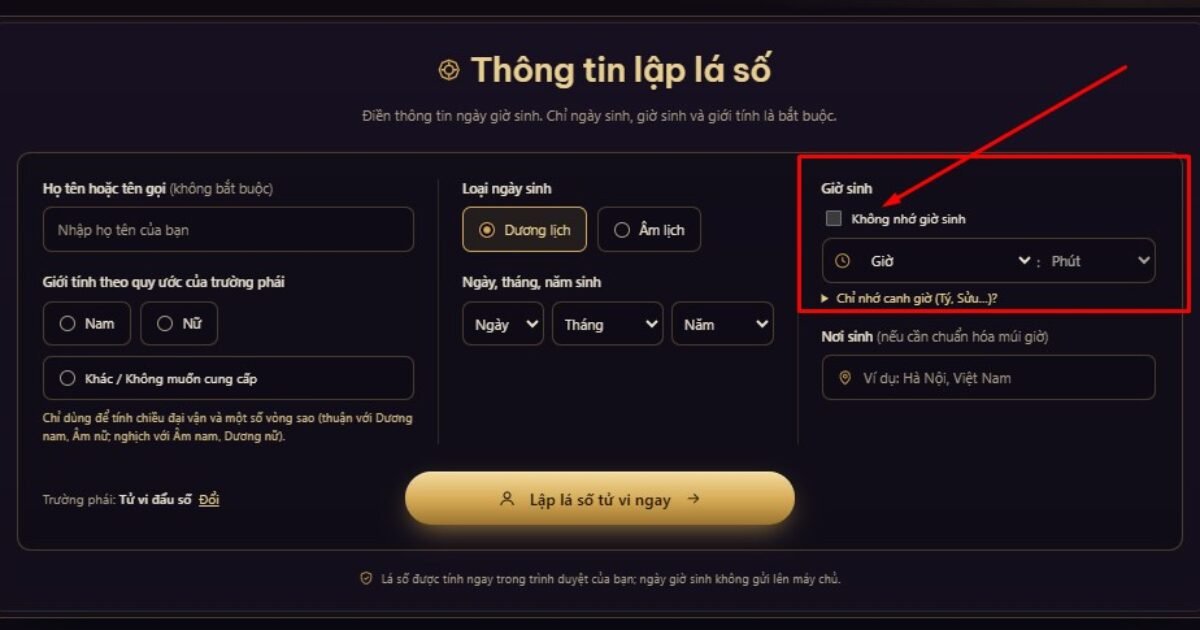
When setting up a Zi Wei chart, the day, month, year and hour of birth are key information for determining the elements of the chart. However, not everyone remembers exactly when they were born. Some only remember morning or evening, some were told an approximate time by their family, and some have no information about their birth hour at all.
So can you set up a Zi Wei chart without knowing your birth hour? Is it possible to chart without this information? And what should you do if you only remember an approximate time?
The article below explains the role of the birth hour, the limits of charting with missing data and how to use the Zi Wei Chart tool at Treasure Land Feng Shui.
1. Can you set up a Zi Wei chart without knowing your birth hour?
The answer is that you can start setting up a chart, but you need to be clear about how much information you have.
In Zi Wei Dou Shu, the birth hour is one of the key inputs. It is used together with the birth day, month, year and gender to place the palaces, determine the positions of the stars and work out the further elements of the reading.
If you don’t know your birth hour, you should not pick an arbitrary hour as a substitute. Entering the wrong hour can produce a star placement and chart layout that do not reflect your actual birth data.
There are three cases:
- No exact birth hour: You don’t know which hour you were born in and have no reliable information to determine it.
- Only an approximate time: For example, you remember being born in the morning, afternoon or at night but can’t pin down a specific slot.
- Only the branch hour: You don’t remember the exact hour and minute but know you were born in the Rat, Ox, Tiger, Rabbit or another branch hour.
Each case is handled differently. The key point is not to treat a chart without a birth hour as equivalent to one with complete data.
2. Why does the birth hour matter when setting up a Zi Wei chart?
In the Zi Wei Dou Shu system, the birth hour is not just information written on the chart. It is data that takes part in placing and determining the chart’s components.
2.1. The birth hour is involved in placing palaces and stars
A Zi Wei chart is built from many components, such as:
- The heavenly board and the earthly board.
- The twelve functional palaces.
- The Life palace and the Body palace.
- The fourteen main stars.
- The minor stars, killing stars and the Four Transformations.
- Xun, Jie and the major luck periods.
When setting up the chart, the birth day, month, year and hour are used according to the star-placement rules of Zi Wei Dou Shu.
So if the birth hour is inaccurate, some elements of the chart may change. Readers need to know exactly which data were used so they don’t treat the result as a complete chart when the input is incomplete.
2.2. The birth hour helps determine the elements of the reading
When reading a Zi Wei chart, readers usually combine palace positions, main stars, minor stars and the relationships between palaces and stars to make judgements according to the traditional system.
The birth hour is part of the base data that forms the chart’s layout. So missing birth-hour information can limit the ability to determine and interpret some elements.
Don’t rely only on the birth day, month and year to draw conclusions about the whole chart, especially if you want to look closely at each palace, the luck periods or the stages of life.
3. What to do if you don’t remember your birth hour
If you don’t remember your birth hour, try to find the information before deciding to use a substitute hour.
3.1. Ask your family
This is the simplest way to recover your birth hour.
You can ask your parents, grandparents or whoever looked after you when you were born. Some families also keep a note of the birth time, a record book or information from the hospital.
When asking, try to establish:
- Were you born in the morning, at noon, in the afternoon or in the evening?
- Does anyone remember a specific time?
- Is the information remembered precisely or only estimated?
- Is there any document or record confirming the time of birth?
The more specific the information, the easier it is to check.
3.2. Check birth documents and records
If you were born in a hospital or clinic, you can check any documents that have been kept.
Some sources to consult include:
- Birth certificate.
- Hospital birth records.
- Family record books.
- Photos or documents kept from the time of birth.
Not every record includes the birth time, but these are still worth checking before resorting to estimation.
3.3. Narrow down the birth time from family information
If you can’t find the exact birth hour but relatives still remember a rough time, record how certain that information really is.
For example:
- Only remembering a morning birth.
- Remembering a birth close to noon.
- Remembering an evening birth.
- Knowing the branch hour but not the exact minute.
Don’t turn these estimates into an exact time unless you have grounds for it.
3.4. Consider birth-time rectification
In traditional Zi Wei practice, there is a method of comparing different possible birth hours with the events and milestones that have occurred in a person’s life. This is usually called birth-time rectification.
The practitioner may consider information such as:
- Important family milestones.
- Education and career history.
- Major changes in life.
- Notable events at each stage of life.
The possible birth hours are then compared using the reading method of the school in use.
However, understand that this is a method of interpretation and comparison in traditional Zi Wei, not a way of verifying the birth hour with absolute accuracy. Subjective judgements can also affect the result.
Rectification should be done carefully; don’t assert a birth hour just because a few personality traits or events seem to match.
4. Cases of missing birth hours when setting up a Zi Wei chart
Not everyone who doesn’t remember their birth hour is missing information in the same way. Distinguish the following cases to choose the right way to enter your data.
4.1. Completely unknown birth hour
If you have no information at all about your birth hour, don’t pick a slot on a hunch.
In this case, you can use the unknown-birth-hour option if the charting tool supports it. The result must be understood within the limits of the input data and should not be assumed to be as complete as a chart with an exactly known birth hour.
4.2. Only the branch hour is known
In the traditional calendar and Zi Wei system, a day is divided into 12 branch hours:
| Branch hour | Time span |
| Rat hour | 23:00 – 00:59 |
| Ox hour | 01:00 – 02:59 |
| Tiger hour | 03:00 – 04:59 |
| Cat hour | 05:00 – 06:59 |
| Dragon hour | 07:00 – 08:59 |
| Snake hour | 09:00 – 10:59 |
| Horse hour | 11:00 – 12:59 |
| Goat hour | 13:00 – 14:59 |
| Monkey hour | 15:00 – 16:59 |
| Rooster hour | 17:00 – 18:59 |
| Dog hour | 19:00 – 20:59 |
| Pig hour | 21:00 – 22:59 |
If you only remember being born in a particular branch hour, you can use that information rather than guessing the hour and minute.
Note that the boundaries of birth hours may be handled according to each charting system’s conventions. In particular, times close to 23:00 need careful handling, as they may affect how the Rat hour and the birth date are calculated.
4.3. Known hour but not the minute
If you know the clock hour of your birth but not the exact minute, give the closest information possible and note how certain it is.
Don’t invent an exact minute when you have no data to confirm it. For births close to the boundary between two branch hours, a time error can make determining the birth hour more critical.
4.4. Born abroad or during a period of time-zone changes
For people born abroad, or in places and historical periods when the time zone changed, pay attention to the place and time of birth.
The time on documents may be the local time at the place of birth. When setting up the chart, the time conversion should be handled using the time zone appropriate to the place and historical period.
So if you were born abroad or have information about your place of birth, provide it when the tool asks, to help standardize the time data.
5. How to set up a Zi Wei chart without knowing your birth hour at Treasure Land Feng Shui
The Zi Wei Chart tool at Treasure Land Feng Shui lets you enter your birth date in the Gregorian or lunar calendar, choose a gender, provide birth-hour information and choose a charting school.
If you don’t remember your birth hour, you can choose the unknown-birth-hour option. If you only remember the branch hour, the tool also supports entering that.
You can follow these steps:
Step 1: Open the Zi Wei chart tool
Open the tool at:
https://phongthuybaodia.com/en/zi-wei-birth-chart/
This page lets you enter your birth date and the other data needed to set up a chart.
Step 2: Enter your personal information
In the form, you can enter a name if you wish, then choose a gender from the options provided.
Gender is used in some traditional rules concerning the direction of luck periods and other charting elements.
Step 3: Choose the type of birth date
The tool supports two ways of entering it:
- Gregorian calendar.
- Lunar calendar.
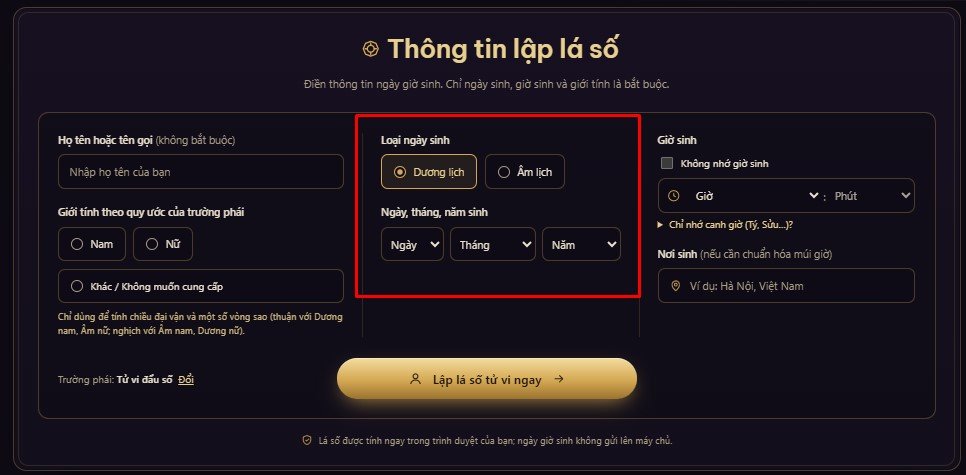
Choose the correct type of birth date before entering the day, month and year. If you use a lunar date, watch out for leap months so you don’t enter the wrong data.
Step 4: Enter your birth hour or choose unknown
This is the step to pay attention to if you don’t remember exactly when you were born.
- If you know the hour and minute of birth, enter the confirmed information.
- If you don’t remember your birth hour, choose the unknown-birth-hour option.
- If you only remember the branch hour, choose the matching branch-hour input method.
Don’t pick a random birth hour just to complete the form.
Step 5: Provide your place of birth if needed
If you were born abroad or during a historical period with time-zone changes, provide your place of birth as the tool asks.
This information helps standardize the time before converting calendars and determining the related data.
Step 6: Choose a charting school
The tool offers these schools:
- Zi Wei Dou Shu.
- Zi Wei with modern interpretation.
- Four Pillars and Ba Zi.
Choose the method that suits what you want to explore. Each system builds and interprets the data in its own way.
Step 7: Create the chart and view the result
After checking the information you entered, you can create the chart.
If the birth hour is missing, pay attention to any warnings or limitations shown in the result. Don’t infer elements that the input data are not sufficient to determine.
6. How does a chart without a birth hour differ from a complete chart?
The most important difference lies in the amount of input data.
| Criterion | With birth hour | Unknown birth hour |
| Date of birth | Yes | Yes |
| Birth-hour information | Determined | Not determined |
| Input data | More complete | Missing the hour |
| Ability to set up the chart | According to the data entered | Limited by the missing hour |
| Reading | Has birth-hour data to check against | Be cautious with conclusions that depend on the birth hour |
Don’t assume that being able to enter your birth date fully replaces the role of the birth hour.
A chart set up from complete data and one missing the birth hour need to be clearly distinguished when examining and interpreting them.
If you later find reliable birth-hour information, set up the chart again with the new data for a more accurate basis of comparison under the system’s rules.
Conclusion
Not remembering your birth hour doesn’t mean you can’t start exploring a Zi Wei chart. However, the birth hour is important data in Zi Wei Dou Shu, so its absence should be clearly noted and handled carefully.
First, ask your relatives, check your documents or look for any surviving information about when you were born. If you only remember the branch hour, you can use that when charting. If you don’t know your birth hour at all, choose the corresponding option rather than entering an arbitrary hour.
You can use the Zi Wei Chart tool at Treasure Land Feng Shui to enter your birth date, choose the appropriate way of declaring your birth hour and see the result based on the data you have.
Editorial information
 Written byTechnical & Visual Design TeamThe unit that designs visual diagrams and keeps the website secure.
 Reviewed byContent Review BoardThe unit that screens material and verifies its accuracy.
Last updated: 21/11/2026
References
- JAHH 2019 PDF
- Aslaksen, The Mathematics of the Chinese Calendar
- Ho Ngoc Duc, Leipzig University
- UNESCO, Twenty-Four Solar Terms
- Truong Anh Thuan, The Hiep Ky calendar under the Nguyen dynasty
- Smith, Chinese Almanacs (book review)
- Smith, Fortune-tellers and Philosophers (book review)
- Ziwei doushu, Wikipedia
- Bruun, An Introduction to Feng Shui
- Feuchtwang, LSE eprints
- Bourassa & Peng 1999
- Bond, Feng Shui and Condominium Prices
Content follows our editorial standards of Treasure Land Feng Shui. Results are for reference, based on traditional beliefs.
Related articles

Which Elements Suit Willow Wood? Compatible and Clashing Elements and Lucky Colors
In the sixty-year Jiazi cycle, Willow Wood is a Na Yin element with a distinctive image. Not an ancient hardwood tree or a vast forest, Willow Wood represents the willow,…
19/11/2026 · 15 min read
Does Wood Control Earth? Causes and Remedies in the Five Elements
In five-element feng shui, Wood and Earth have a controlling relationship. Wood represents trees, growth and development, while Earth represents land, stability and nourishment. This difference leaves many people unsure…
18/11/2026 · 10 min read
What Is the Su Xi Hour? Meaning, Calculation and What to Do
In the tradition of choosing days and hours, Su Xi (Swift Joy) is seen as a time that brings joy, luck and favorable turns in one’s affairs. People in the…
16/11/2026 · 9 min read