
Chinese Astrology
Do Auspicious Hours Need to Match Your Age? How to Choose the Right Hour
Do auspicious hours need to match your age? Learn how to find good hours by day, check them against age and choose a suitable time slot in the traditional way.

Do auspicious hours need to match your age? It is a common question when choosing a time for a wedding, grand opening, groundbreaking, moving house or a journey. In traditional calendar belief, auspicious hours are determined from the specific day, while checking the person’s age helps weigh the compatibility between the timing and the person leading the undertaking.
Checking age compatibility is not required in every case. For ordinary tasks, you can consult the day’s general auspicious hours. For important events, if you wish to follow custom, you can also check the age of the person leading the event for a more informed choice.
1. Do auspicious hours need to match your age?
In feng shui and folk calendar belief, choosing an hour is usually considered from two angles: whether the hour is classed as Yellow Path for that day, and whether it suits the age of the person carrying out the task.
Auspicious hours are time slots determined by the traditional calendar system. The result does not change just because users have different birth years. Checking age compatibility, on the other hand, is a supplementary step, usually applied when the household wants to choose a time by more criteria.
So, put simply:
- Checking auspicious hours: identifies the time slots classed as Yellow Path for the day.
- Checking age compatibility: also weighs the relationship between the chosen hour and the age of the person leading the event.
- Combining both: prefer the Yellow Path slots, then check against age if the task and family custom call for it.
Note that this is a choice based on traditional belief; there is no scientific evidence that choosing an age-compatible hour increases the chance of an event’s success.
2. Do the day’s general auspicious hours apply to everyone?
In principle, the general auspicious hours are determined by the lunar date and the calendar method used. A day usually has six Yellow Path and six Black Path slots under the common 12-deity system.
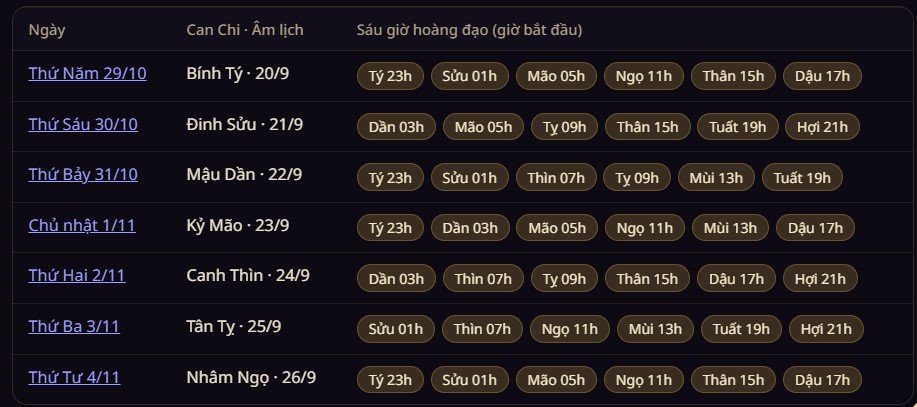
These slots are looked up by day; each person does not have an entirely separate set of auspicious hours based only on their birth year.
However, when choosing an hour for a specific task, some feng shui methods also consider the age of the person leading it, the nature of the task and the avoidance rules applied by the family or the ceremony.
For example, if the Rat hour is Yellow Path on a given day, a person born in a Horse year will still see the Rat hour in the general result. But by earthly-branch belief, Rat and Horse are a clashing pair. Someone using a method that factors in age may therefore consider another Yellow Path slot that doesn’t break the avoidance rule they follow.
This does not mean the Rat hour loses its Yellow Path classification for that day. The two results belong to two different layers: the day’s hour classification and the assessment of age compatibility.
3. How to choose an age-compatible auspicious hour in the traditional way
If you want to choose an hour that is both Yellow Path and suited to the age of the person leading the event, you can follow this order.
Step 1: Decide the day you plan to carry out the task
First, decide the Gregorian or lunar date you intend to use. If you already have a specific day, look up that exact day to find its lunar date and stem-branch.
You can use the Auspicious Hours tool at Treasure Land Feng Shui to look up the day’s information and the list of auspicious slots according to the method shown on the page.
Step 2: Filter the auspicious slots of the day
Once you have the result, note down the slots classed as Yellow Path. This is the starting list to choose from, rather than checking age before determining the day’s good hours.
Don’t assume that a fixed hour such as the Dragon or Rat hour is always auspicious. The list must be looked up for the specific day and the calendar system in use.
Step 3: Compare the hour’s branch with the person’s age
In the system of 12 earthly branches, each time slot corresponds to a branch. In folk belief, some pairs of branches clash, combine or punish each other.
For example, Rat – Horse is a clashing pair. So a person born in a Horse year who uses a method that considers age clashes may avoid the Rat hour if that rule applies to the task at hand.
However, don’t rely on a single pair of branches to conclude whether an hour is entirely good or bad for someone. Interpretations may differ by school and by which factors are taken into account.
Step 4: Consider the heavenly stems and five elements if needed
Besides the earthly branch, some methods also compare the heavenly stems and five elements of the person’s age with the chosen time.
Considering these factors must be based on a specific system of interpretation. Don’t conclude that an hour of the same element as one’s age is certainly good, or that one of a different element is certainly bad, without first establishing the generating and controlling rules and how they apply.
If you only need to choose an auspicious hour by day, you don’t have to go through this whole in-depth process.
Step 5: Choose a slot that fits your actual schedule
After comparing, prefer the slot that meets the needs of the task, fits the schedule and doesn’t break the avoidance rules the family has decided on.
If there are several equivalent options under the method you are using, you can choose the more convenient hour rather than trying to find the single time considered best.
4. When should you also check age compatibility?
How much attention is paid to age can vary with the nature of the task and family custom.
| Situation | How to consult |
| Everyday tasks | You can look up the general auspicious hours if you want to choose a time by the traditional calendar. |
| Travel | Consult the auspicious hours, then consider age if you wish to follow custom. |
| Grand openings, signings | You can combine auspicious hours with the age of the person leading the event using the method the family prefers. |
| Weddings | Agree on the method with both families and the ceremony adviser if you follow the custom of choosing hours. |
| Groundbreaking, moving house | You can consult days and hours by the calendar and check against the head of the household’s age if custom requires. |
The table above is a reference guide, not a mandatory rule for every family or every feng shui school.
5. Should you drop an auspicious hour if it doesn’t match your age?
Don’t rush to conclude that an auspicious slot must be dropped just because one factor doesn’t suit the person’s age.
First, distinguish the general auspicious-hour result from the age-compatibility reading. A slot may still be classed as Yellow Path for the day while a particular age-based method recommends considering another hour.
If there are several auspicious slots to choose from, compare each one with the age and the schedule. If no hour meets all the criteria you use, review how you prioritize each criterion rather than concluding that the task can’t be done that day at all.
In particular, don’t delay necessary matters or make important financial, health or legal decisions based solely on the result of choosing an hour.
6. Where to look up auspicious hours and check them against age?
You can start with the Auspicious Hours tool – Treasure Land Feng Shui.
The tool provides the lunar date, the day’s stem-branch, the Green Dragon starting hour, a classification of Yellow Path and Black Path hours, and auspicious-hour calendars for the next 7 days and the whole month. This is the basis for drawing up the list of hours to consider.
Note that looking up the general auspicious hours does not mean the tool has completed a personal age-compatibility reading. If you want to consider the heavenly stems, earthly branches and five elements by age, use the corresponding method of interpretation and check the rules it applies.
Editorial information
 Written byTechnical & Visual Design TeamThe unit that designs visual diagrams and keeps the website secure.
 Reviewed byContent Review BoardThe unit that screens material and verifies its accuracy.
Last updated: 21/11/2026
References
- JAHH 2019 PDF
- Aslaksen, The Mathematics of the Chinese Calendar
- Ho Ngoc Duc, Leipzig University
- UNESCO, Twenty-Four Solar Terms
- Truong Anh Thuan, The Hiep Ky calendar under the Nguyen dynasty
- Smith, Chinese Almanacs (book review)
- Smith, Fortune-tellers and Philosophers (book review)
- Ziwei doushu, Wikipedia
- Bruun, An Introduction to Feng Shui
- Feuchtwang, LSE eprints
- Bourassa & Peng 1999
- Bond, Feng Shui and Condominium Prices
Content follows our editorial standards of Treasure Land Feng Shui. Results are for reference, based on traditional beliefs.
Related articles
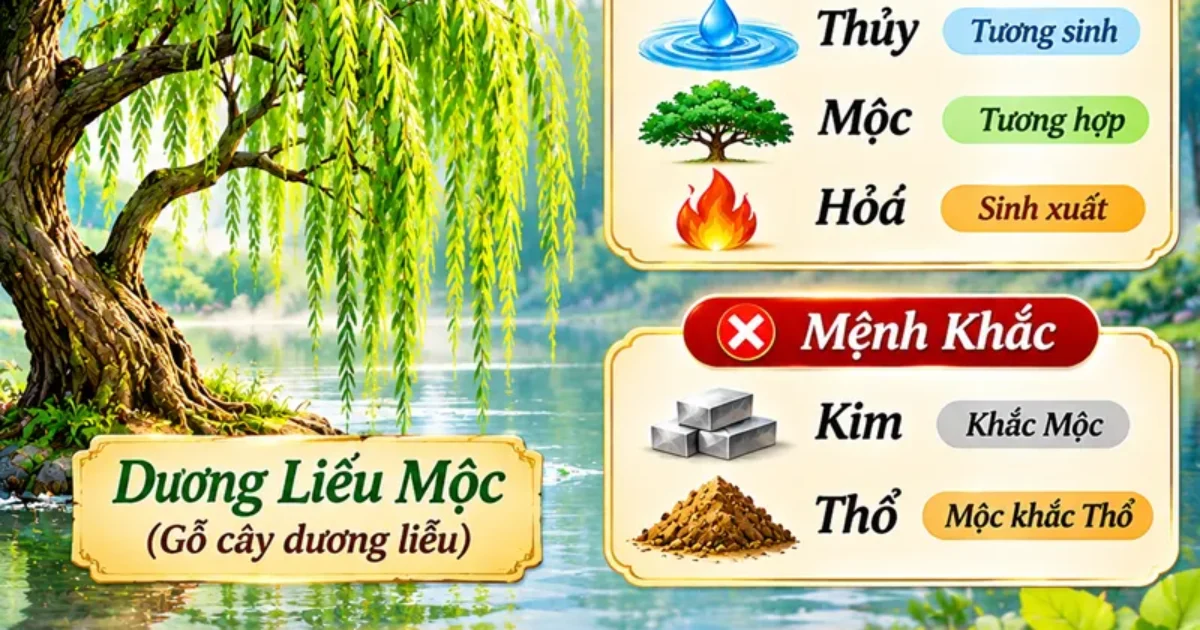
Which Elements Suit Willow Wood? Compatible and Clashing Elements and Lucky Colors
In the sixty-year Jiazi cycle, Willow Wood is a Na Yin element with a distinctive image. Not an ancient hardwood tree or a vast forest, Willow Wood represents the willow,…
19/11/2026 · 15 min read
Does Wood Control Earth? Causes and Remedies in the Five Elements
In five-element feng shui, Wood and Earth have a controlling relationship. Wood represents trees, growth and development, while Earth represents land, stability and nourishment. This difference leaves many people unsure…
18/11/2026 · 10 min read
What Is the Su Xi Hour? Meaning, Calculation and What to Do
In the tradition of choosing days and hours, Su Xi (Swift Joy) is seen as a time that brings joy, luck and favorable turns in one’s affairs. People in the…
16/11/2026 · 9 min read