
Chinese Astrology
How to Find Good Hours by Lunar Date Online

To check the good hours of a lunar day, you can use the Auspicious Hours tool at Treasure Land Feng Shui. It shows the lunar date, the day’s stem-branch, the starting hour of the Green Dragon, and the auspicious and inauspicious hours of the day. You can also see the good hours for the next 7 days or look up a whole month to plan ahead.
Below is a step-by-step guide to using the tool.
Step 1: Choose the day to check
Go to the Auspicious Hours page and find the Choose date (Gregorian) field at the top.
Choose the day you want to look up. Once the day is set, the tool shows the matching details such as the day of the week, the lunar date, the lunar year and the day’s stem-branch.
You can also use the navigation links provided:
- Previous day: see the result for the day before.
- Today: go back to the current day.
- Next day: see the result for the following day.
- View by lunar date: switch to looking up by lunar date if the interface supports it.
Check the chosen date before reading the result so you don’t look up the wrong day.
Step 2: Choose the Rat-hour convention
In the Rat-hour convention field, the tool offers the option Change day at 00:00 (early Rat – late Rat).
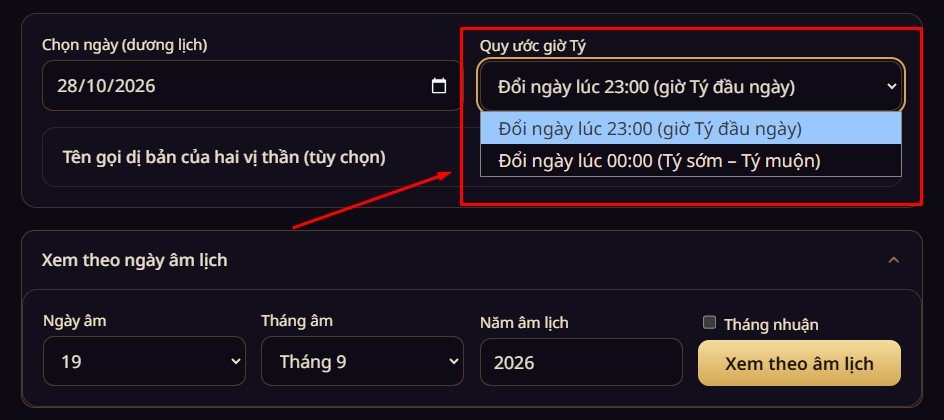
This setting concerns how the Rat hour is split when determining the day being looked up. With the change-at-00:00 convention, 23:00–24:00 is shown as late Rat and still belongs to the day being viewed; 00:00–01:00 is early Rat.
If you have no need for another convention, you can keep the default. When comparing the result with a perpetual calendar or another tool, check the Rat-hour convention to understand why the data may differ.
Step 3: Optional variant names for two deities
In the Variant names for two deities (optional) section, you can choose alternative names for the 6th and 10th deities.
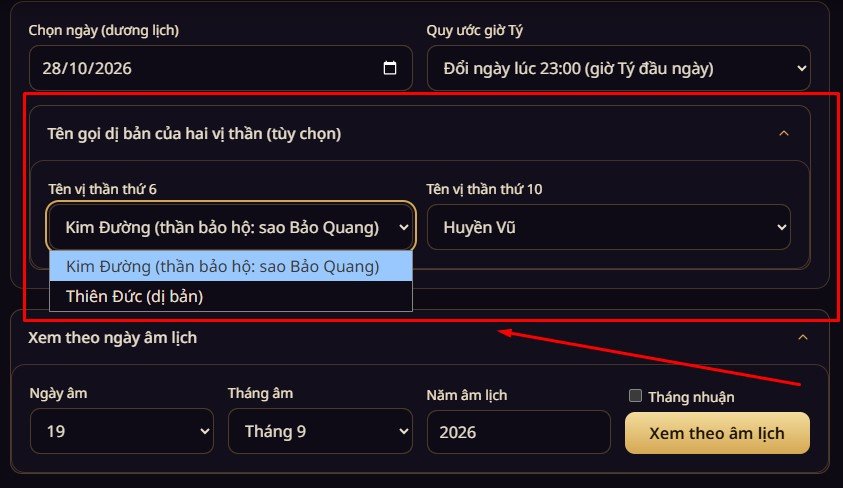
For example, the interface shows the variant choices Heavenly Virtue and Primordial Warrior. This is only an option for how names appear in the result; it is not required for looking up auspicious hours.
If you don’t need to change the names, you can keep the default choices.
Step 4: Read the lunar date and the day’s stem-branch
After choosing the day, look at the overview area of the result.

The details to note are:
- Lunar date: the lunar date matching the chosen Gregorian date.
- Day stem-branch: the stem-branch name of the day, used to look up hours in the traditional calendar system.
- Green Dragon starting hour: the hour where the cycle of 12 hour deities begins under the rule the tool applies.
- Day class: whether the day is a Yellow Path or Black Path day in the system shown on the page.
Two concepts should be kept apart: a Yellow Path day is a classification of the day, while auspicious hours are the time slots classed as Yellow Path within that day. A day shown as a Yellow Path day does not mean every hour of the day is auspicious.
Step 5: See the list of auspicious hours for the day
Scroll down to Time slots of the day to see the detailed result table.
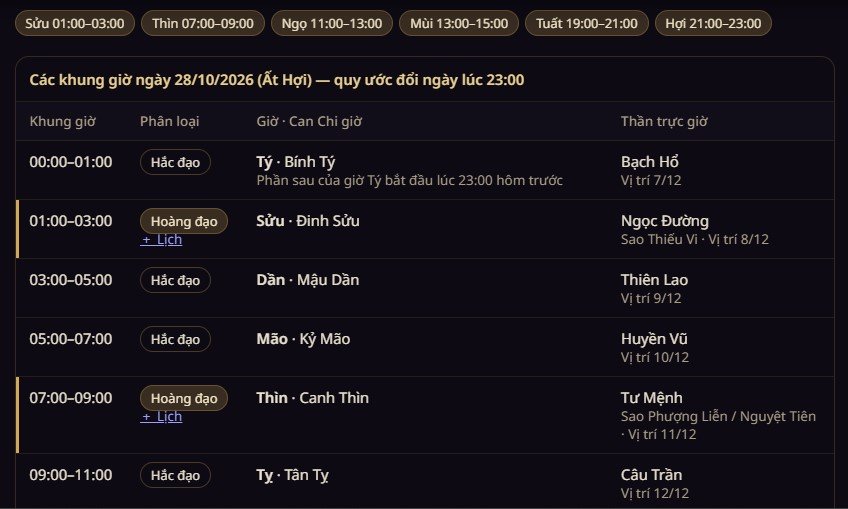
The table shows the main details:
- Time slot: start and end times in local clock time.
- Class: whether the slot is auspicious (Yellow Path) or inauspicious (Black Path).
- Hour – hour stem-branch: the name of the hour by earthly branch and its stem-branch.
- Hour deity: the deity assigned to each position in the cycle of 12 deities.
Auspicious slots are highlighted in the table so they are easy to spot. You can compare the clock times with your actual schedule to choose a suitable slot.
For example, for 31/10/2026, the sample result on the tool shows a Wu Yin day and lists six auspicious hours under the system in use: Rat, Ox, Dragon, Snake, Goat and Dog. The matching time ranges are 23:00–01:00, 01:00–03:00, 07:00–09:00, 09:00–11:00, 13:00–15:00 and 19:00–21:00. The Rat hour is shown as early Rat and late Rat according to the chosen day-change convention.
This is an example from the tool’s sample result, not a fixed list of good hours for every day.
Step 6: Compare the two ways of looking up auspicious hours
If you want to understand the result better, see the Comparing two methods for this day section.
The tool presents results using the 12-deity system and the table of six day-branch groups. When the two methods give the same set of six hours, the result notes that the two methods agree.
If the results differ, review the chosen date, the day’s stem-branch and the method used before drawing conclusions. Don’t automatically assume a result is wrong just because it differs from another source, as calendar systems may use different classification rules.
Step 7: See auspicious hours for the next 7 days or the whole month
If you need to plan ahead, use the two extended calendar sections of the tool.
Auspicious hours for the next 7 days: shows the date, stem-branch, lunar date and the six matching auspicious hours. You can compare nearby days to find a time that fits your schedule.
Auspicious hours for the whole month: lets you look up many days of the month without choosing them one by one. This is useful when preparing work that needs to be scheduled early.
The tool also has an option to show only daytime hours between 05:00 and 19:00 in the 7-day and monthly tables. Turn it on if you want to focus on daytime slots.
Step 8: Copy the link or print the result table
After looking up, you can use the Copy link and Print table functions in the interface.
- Copy link: save or share the link to reopen the result.
- Print table: print the auspicious-hour information to follow and compare easily.
Before saving or printing, double-check the Gregorian date, the lunar date and the Rat-hour convention to make sure the result matches what you need.
Notes on checking good hours by lunar date
Auspicious and inauspicious hours belong to the traditional Eastern calendar system. Methods may differ in their calculation rules and presentation, so use results from one consistent system when comparing.
The information from the tool is intended as a cultural and traditional reference and a calendar lookup aid. The result is not scientific proof that an undertaking will succeed. When choosing when to do something, you should still consider your schedule, practical conditions and other relevant requirements.
Editorial information
 Written byTechnical & Visual Design TeamThe unit that designs visual diagrams and keeps the website secure.
 Reviewed byContent Review BoardThe unit that screens material and verifies its accuracy.
Last updated: 21/11/2026
References
- JAHH 2019 PDF
- Aslaksen, The Mathematics of the Chinese Calendar
- Ho Ngoc Duc, Leipzig University
- UNESCO, Twenty-Four Solar Terms
- Truong Anh Thuan, The Hiep Ky calendar under the Nguyen dynasty
- Smith, Chinese Almanacs (book review)
- Smith, Fortune-tellers and Philosophers (book review)
- Ziwei doushu, Wikipedia
- Bruun, An Introduction to Feng Shui
- Feuchtwang, LSE eprints
- Bourassa & Peng 1999
- Bond, Feng Shui and Condominium Prices
Content follows our editorial standards of Treasure Land Feng Shui. Results are for reference, based on traditional beliefs.
Related articles

Which Elements Suit Willow Wood? Compatible and Clashing Elements and Lucky Colors
In the sixty-year Jiazi cycle, Willow Wood is a Na Yin element with a distinctive image. Not an ancient hardwood tree or a vast forest, Willow Wood represents the willow,…
19/11/2026 · 15 min read
Does Wood Control Earth? Causes and Remedies in the Five Elements
In five-element feng shui, Wood and Earth have a controlling relationship. Wood represents trees, growth and development, while Earth represents land, stability and nourishment. This difference leaves many people unsure…
18/11/2026 · 10 min read
What Is the Su Xi Hour? Meaning, Calculation and What to Do
In the tradition of choosing days and hours, Su Xi (Swift Joy) is seen as a time that brings joy, luck and favorable turns in one’s affairs. People in the…
16/11/2026 · 9 min read