
Good days
What Is a Yellow Path Day? Meaning and How to Find Good Days
What is a Yellow Path day? Learn its meaning, how it differs from Black Path days and auspicious hours, and how to look up good days for each activity.
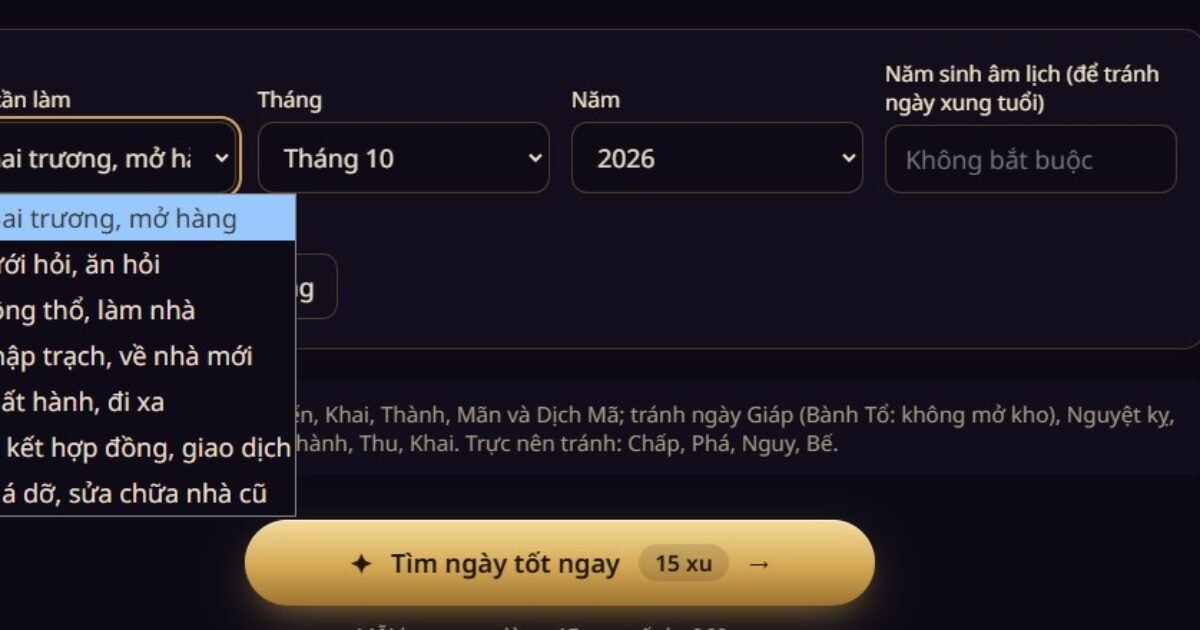
What is a Yellow Path day, and why do many people choose such days for weddings, grand openings, groundbreaking or moving house? In folk belief, a Yellow Path day is one thought to be governed by benevolent deities, carrying an auspicious meaning that favors important undertakings.
To understand the concept better, you need to distinguish Yellow Path days from Black Path days, know which activities people usually choose days for and understand how to look up the information on the lunar calendar.
1. What is a Yellow Path day?
A Yellow Path day is a day considered auspicious in the traditional Eastern calendar, tied to the belief that benevolent deities govern or protect that day. People of old believed that choosing a Yellow Path day for important undertakings could bring smooth progress, luck and peace of mind.
The concept comes from the calendar system and folk belief, in which good and bad days are judged by traditional rules involving the lunar date, stem-branches and the system of deities.
A Yellow Path day is not the same as a public holiday or a special day in the Gregorian calendar. An ordinary Gregorian date can still be classed as a Yellow Path day under the calendar method in use.
Note that the lucky meaning of Yellow Path days belongs to cultural and traditional belief; there is no scientific evidence that such a day automatically makes an undertaking succeed.
2. What does a Yellow Path day mean?
Traditionally, choosing an auspicious day expresses the wish for a smooth start and avoiding things that worry the household. Yellow Path days are consulted for many activities.
- Weddings and engagements: Families may choose a Yellow Path day for the ceremony, hoping for a harmonious married life.
- Grand openings, first sales: Some people choose a day considered good to start a business.
- Groundbreaking, building a house: Yellow Path days may be consulted when preparing to start construction.
- Moving house: The household may choose a day that suits family custom before moving to a new home.
- Signing contracts, transactions: People who value the custom of choosing days may consult Yellow Path days before an important transaction.
- Setting out: Some people check the calendar for good days before a trip to choose when to depart in the traditional way.
Choosing a day should be weighed together with practical conditions such as work schedules, timetables, weather and the readiness of those involved. A Yellow Path day doesn’t replace the factors that directly determine the outcome.
3. How do Yellow Path days differ from Black Path days?
Black Path days are usually seen as the opposite of Yellow Path days in the folk calendar.
| Criterion | Yellow Path day | Black Path day |
| Traditional belief | A day considered auspicious | A day considered less favorable |
| Interpretation style | Tied to the protection of benevolent deities | Tied to the rule of malevolent deities in folk belief |
| How they are used | Usually consulted when choosing a day for important matters | Calendar readers may think more carefully before choosing it |
| Practical meaning | Gives peace of mind according to custom | A reference within a belief system |
Classifying Yellow Path and Black Path days must be based on a specific calendar method. Don’t assume every task done on a Black Path day will go badly or every task done on a Yellow Path day will certainly succeed.
4. Are Yellow Path days the same as auspicious hours?
Yellow Path days and auspicious hours are related but are two different concepts.
A Yellow Path day is the result of classifying days under the traditional calendar. Auspicious hours, meanwhile, are the time slots classed as Yellow Path within a specific day.

Under the common system of 12 hour deities, a day is usually divided into 12 slots by the 12 earthly branches, of which six are Yellow Path and six are Black Path.
This means a day classed as Yellow Path does not mean every slot of that day is an auspicious hour. If you want to determine when to start a ceremony or task, look up the specific time slot too rather than relying only on the day’s label.
5. How are Yellow Path days determined?
Yellow Path days are determined by the rules of the traditional calendar system. The information usually used in looking them up includes the lunar date, the day’s stem-branch, the system of deities and the method of classifying days.
Depending on the system, the result may come with information such as:
- Lunar date: identifies the day in the lunar calendar.
- Day stem-branch: the day’s name in the system of heavenly stems and earthly branches.
- Day officer: information used in some methods of judging good and bad days.
- Stars and supporting factors: the grounds included in each system’s reading.
- Age of the person leading the event: an additional factor if you want to choose a day compatible with age by custom.
Not every method uses the same set of criteria or the same scoring. So when looking up several sources, check the published method rather than assuming every good-day calendar must give the same result.
6. How to look up Yellow Path days at Treasure Land Feng Shui
You can use the Good Days tool – Treasure Land Feng Shui to find days that suit your needs.
Using the tool’s interface, you can do the following:
Step 1: Choose the activity. Select the type of activity, such as a grand opening, wedding, groundbreaking, moving house, setting out or signing a contract.
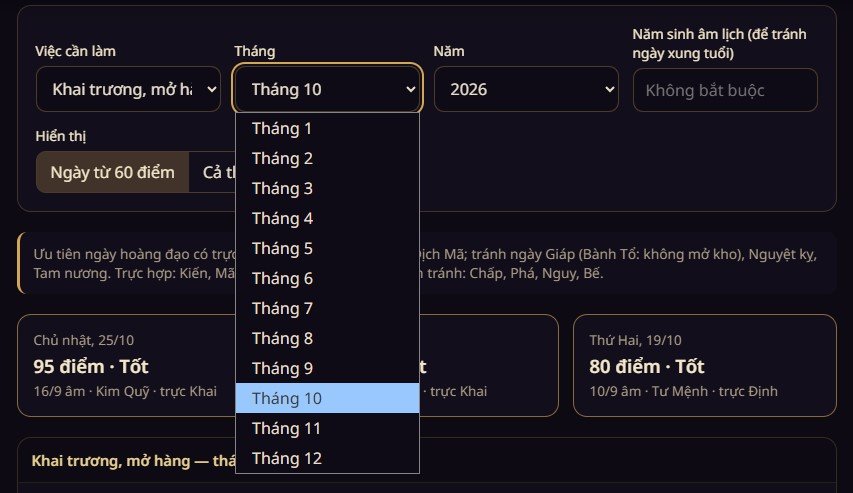
Step 2: Choose the month and year. Set the period you want to search so the tool finds days within it.
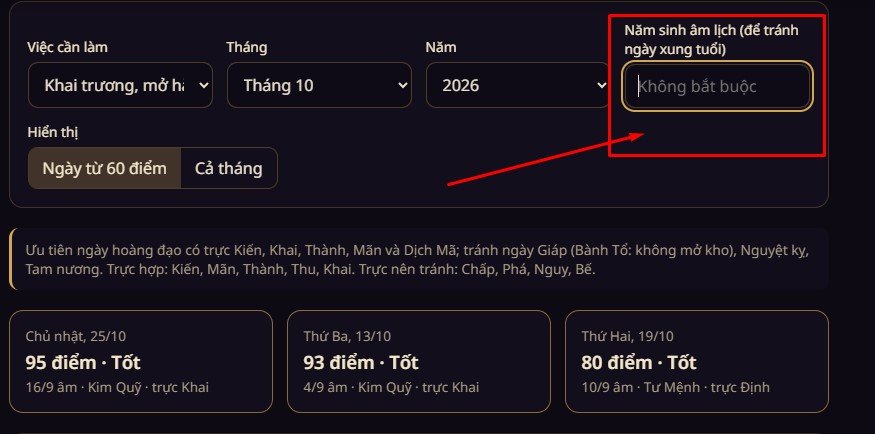
Step 3: Enter your lunar birth year if needed. This optional field is used when you want to also check age clashes as configured in the tool.
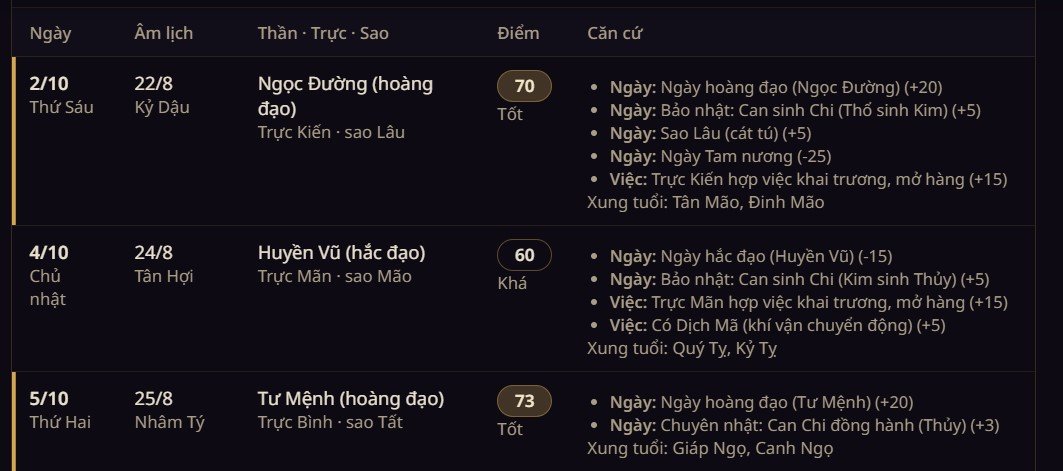
Step 4: View the list of results. Check the Gregorian date, lunar date, stem-branch, day officer, stars and the score shown.
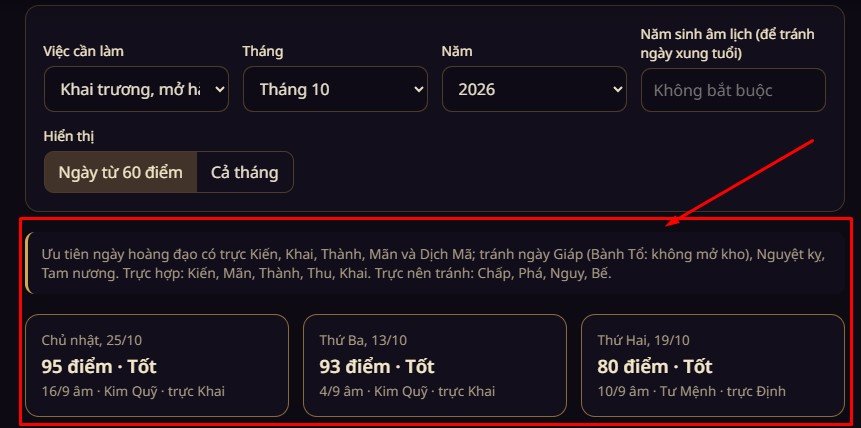
Step 5: Read the reasoning. Rather than looking only at the overall score, look at the good and fair factors and the notes on age, the day or the nature of the activity.
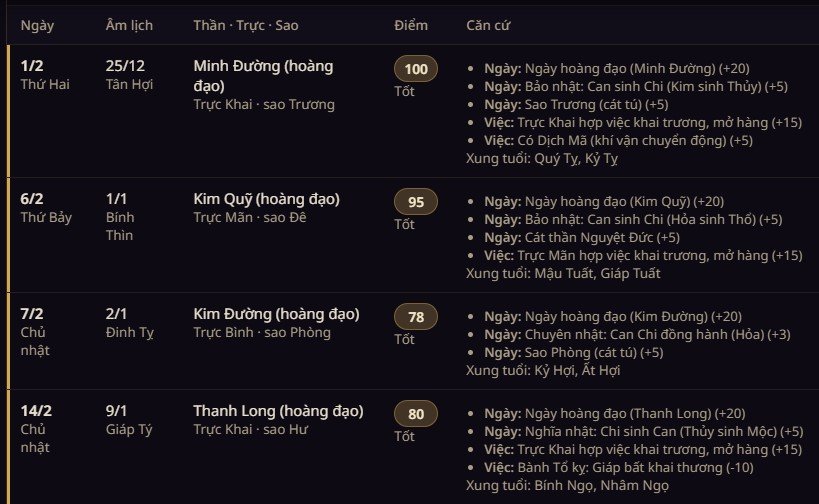
The score on the tool reflects that system’s calculation, not a universal scientific scale. Look at the score together with the reasoning to understand why a day is recommended.
7. Do you need to check age when choosing a Yellow Path day?
Checking age is not required to understand or look up the general Yellow Path days. However, by traditional custom, some families want to check the age of the person leading the event before deciding on a wedding, groundbreaking or house-moving date.
In that case, the reader may consider factors such as stem-branches, clash and harmony relationships and the specific rules of the method being applied.
Distinguish two results: a day classed as Yellow Path by the calendar and a day chosen after also checking age. A day may be classed as Yellow Path in general but not meet every criterion of a particular age-compatibility method.
If the family has its own custom, agree on the method of choosing days from the start to avoid each source reaching a different conclusion.
Conclusion
Yellow Path days are a concept of the traditional lunar calendar and folk belief, consulted by many people when choosing the timing of important matters. To understand them correctly, distinguish Yellow Path days from Black Path days and auspicious hours, and check how the source you use calculates them.
If you want to find days by type of activity, you can consult the tool at Treasure Land Feng Shui, looking at both the results and the reasoning rather than relying only on the Yellow Path label or the score.
Editorial information
 Written byTechnical & Visual Design TeamThe unit that designs visual diagrams and keeps the website secure.
 Reviewed byContent Review BoardThe unit that screens material and verifies its accuracy.
Last updated: 21/11/2026
References
- JAHH 2019 PDF
- Aslaksen, The Mathematics of the Chinese Calendar
- Ho Ngoc Duc, Leipzig University
- UNESCO, Twenty-Four Solar Terms
- Truong Anh Thuan, The Hiep Ky calendar under the Nguyen dynasty
- Smith, Chinese Almanacs (book review)
- Smith, Fortune-tellers and Philosophers (book review)
- Ziwei doushu, Wikipedia
- Bruun, An Introduction to Feng Shui
- Feuchtwang, LSE eprints
- Bourassa & Peng 1999
- Bond, Feng Shui and Condominium Prices
Content follows our editorial standards of Treasure Land Feng Shui. Results are for reference, based on traditional beliefs.
Related articles

What Is the Su Xi Hour? Meaning, Calculation and What to Do
In the tradition of choosing days and hours, Su Xi (Swift Joy) is seen as a time that brings joy, luck and favorable turns in one’s affairs. People in the…
16/11/2026 · 9 min read
What Is the Jade Hall Hour? Meaning and What to Do to Welcome Good Fortune
In Eastern culture, choosing a good hour before starting something important has become a habit for many families. Alongside familiar slots like the Green Dragon, Bright Hall or Golden Coffer,…
15/11/2026 · 5 min read
Yellow Path Days in November 2026 by the Lunisolar Calendar
Look up the Yellow Path days of November 2026, their lunar dates and reference information for choosing a day for weddings, grand openings, groundbreaking and journeys.
21/10/2026 · 6 min read